Work Health and Safety: A Comprehensive 2026 Guide
Work Health and Safety: A Comprehensive 2026 Guide

Work health and safety remains a fundamental pillar of successful business operations across all sectors in 2026. As organisations continue to navigate increasingly complex regulatory landscapes and evolving workplace hazards, maintaining robust safety systems has become more critical than ever. The effectiveness of these systems depends not only on regulatory compliance but also on a genuine commitment to protecting employees, contractors, and visitors from harm. For engineering and industrial sectors particularly, where equipment hazards and operational risks are inherent, establishing comprehensive safety frameworks ensures both legal adherence and operational excellence.
Understanding the Foundations of Work Health and Safety
The concept of work health and safety encompasses far more than simply meeting minimum legal requirements. It represents a holistic approach to identifying, assessing, and controlling risks that could potentially harm people in the workplace. This systematic approach integrates physical safety measures, health protection protocols, and welfare considerations into daily operations.
Modern work health and safety management has evolved significantly from reactive incident response to proactive risk prevention. Organisations now recognise that effective safety systems deliver tangible business benefits including reduced insurance premiums, improved productivity, enhanced reputation, and better employee retention. The Occupational Safety and Health Administration provides extensive resources highlighting how comprehensive safety programmes contribute to organisational success.
The Business Case for Prioritising Safety
Investment in work health and safety delivers measurable returns across multiple dimensions. Beyond the obvious humanitarian imperative, robust safety systems reduce operational disruptions, minimise compensation claims, and protect organisations from regulatory penalties.
Reduced incident rates leading to fewer lost working days
Lower insurance premiums through demonstrated risk management
Enhanced productivity from employee confidence and morale
Improved compliance reducing legal and financial exposure
Stronger reputation attracting quality employees and clients
Research demonstrates that organisations with mature safety cultures consistently outperform competitors across financial and operational metrics. The correlation between safety investment and business performance has become increasingly clear through comprehensive industry studies.

Regulatory Framework and Compliance Requirements
UK work health and safety legislation establishes clear responsibilities for employers, employees, and third parties. The Health and Safety at Work etc. Act 1974 provides the overarching framework, supplemented by specific regulations addressing particular hazards and equipment types.
Understanding inspection regulations forms a crucial component of compliance for organisations operating machinery, lifting equipment, or pressure systems. These statutory requirements mandate periodic examinations by competent persons to verify equipment remains safe for continued use.
Key Statutory Inspection Obligations
Different equipment categories attract specific regulatory requirements with defined inspection frequencies and documentation standards. The four primary regulatory frameworks governing engineering inspections include:
Regulation | Equipment Covered | Typical Frequency | Documentation Required |
|---|---|---|---|
LOLER 1998 | Lifting equipment, hoists, cranes | 6-12 months | Thorough examination reports |
PUWER 1998 | Work equipment, machinery | Risk-based | Inspection records, maintenance logs |
PSSR 2000 | Pressure systems, vessels | Varies by written scheme | Scheme of examination, reports |
COSHH 2002 | LEV systems, extraction units | 14 months | LEV test certificates |
Compliance extends beyond simply scheduling inspections. Organisations must maintain comprehensive records, implement recommendations promptly, and demonstrate continuous improvement in safety management systems. COSHH and LEV inspections help protect employees from hazardous substances whilst ensuring ventilation systems function effectively.
Employer Duties and Responsibilities
The legal framework places primary responsibility for work health and safety with employers. This responsibility cannot be delegated, though specific tasks may be assigned to competent individuals. Employers must conduct suitable risk assessments, implement appropriate control measures, provide adequate training, and maintain safe equipment.
Due diligence requires organisations to demonstrate active management of safety risks. This includes staying informed about emerging hazards, updating risk assessments when circumstances change, and consulting employees about safety matters. The National Institute for Occupational Safety and Health offers evidence-based guidance supporting organisations in meeting these obligations.
Risk Assessment and Hazard Management
Effective work health and safety management begins with systematic identification and assessment of workplace hazards. The risk assessment process provides the foundation for determining appropriate control measures and prioritising safety investments.
The Five-Step Risk Assessment Process
Identify hazards - Walk through the workplace systematically, observing processes, equipment, and activities that could cause harm
Determine who might be harmed - Consider employees, contractors, visitors, and vulnerable groups who may face different risk levels
Evaluate risks and controls - Assess the likelihood and severity of harm, reviewing existing control measures
Record findings - Document significant risks, existing controls, and planned improvements
Review and update - Revisit assessments when circumstances change or at regular intervals
This structured approach ensures consistency across different workplace areas and operational activities. Risk assessments should be living documents, regularly reviewed and updated rather than static compliance exercises.
Understanding workplace danger requires recognising both obvious and hidden hazards that may not be immediately apparent. Manufacturing environments present numerous potential risks including moving machinery parts, stored energy, chemical exposures, noise levels, and manual handling requirements.
Implementing Effective Control Measures
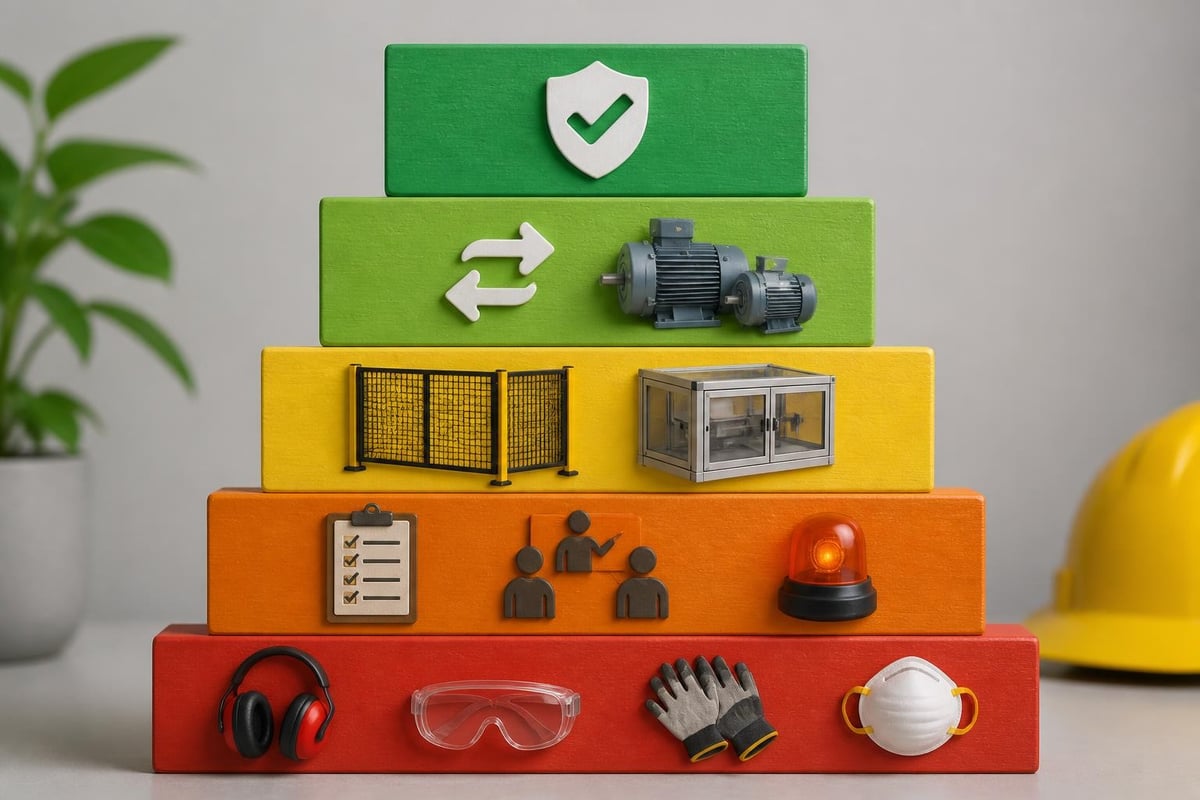
Once risks have been identified and assessed, organisations must implement appropriate control measures following the hierarchy of controls. This systematic approach prioritises eliminating hazards entirely before considering less effective protective measures.
Hierarchy of Controls in Practice
The most effective control measures eliminate hazards completely. When elimination proves impractical, organisations should progress through substitution, engineering controls, administrative controls, and finally personal protective equipment.
Elimination: Remove the hazard entirely (automating a dangerous manual process)
Substitution: Replace with something less hazardous (water-based instead of solvent-based chemicals)
Engineering controls: Isolate people from hazards (machine guarding, ventilation systems)
Administrative controls: Change how people work (job rotation, safe systems of work)
PPE: Protect the individual (safety glasses, gloves, respirators)
Many work health and safety challenges require multiple control layers. Engineering controls provide the most reliable protection as they don't depend on human behaviour remaining consistent. However, organisations typically implement several control types to achieve adequate risk reduction.
For warehousing and logistics operations, even seemingly simple processes require careful consideration. Suppliers like Pallet Company Pro contribute to workplace safety by providing quality pallets that reduce handling risks and ensure stable load configurations during storage and transport activities.
Training and Competency Development
No work health and safety system succeeds without adequately trained personnel. Competency requirements extend beyond basic awareness to include role-specific knowledge, practical skills, and the authority to stop work when safety concerns arise.
Essential Training Components
Comprehensive training programmes address multiple dimensions of workplace safety. Initial induction training introduces fundamental concepts, whilst ongoing development ensures employees maintain current knowledge and skills.
Training Type | Target Audience | Key Content | Frequency |
|---|---|---|---|
Induction | All new starters | Site rules, emergency procedures, reporting | Day one |
Role-specific | Equipment operators | Safe operation, pre-use checks, limitations | Before use |
Refresher | All employees | Updated procedures, incident lessons | Annual |
Specialist | Supervisors, managers | Risk assessment, investigation, leadership | As required |
Training effectiveness depends on relevance, engagement, and practical application. Theoretical knowledge alone proves insufficient; employees must develop confidence applying safety principles in realistic workplace situations. Regular safety inspections provide opportunities to reinforce training and identify knowledge gaps requiring additional support.
Building a Safety Culture
Technical compliance represents only part of effective work health and safety management. Organisations with strong safety cultures demonstrate consistent commitment from leadership, genuine employee participation, and transparent communication about risks and incidents.
Leadership visibility in safety matters influences employee attitudes significantly. When senior managers regularly discuss safety, participate in inspections, and allocate resources for improvements, employees recognise the genuine priority placed on protection. This cultural foundation enables work health and safety systems to function effectively rather than existing merely as bureaucratic exercises.
Equipment Management and Statutory Inspections
Engineering equipment requires systematic management throughout its lifecycle to maintain safe operating condition. From initial acquisition through daily use to eventual decommissioning, organisations must demonstrate active oversight of equipment safety.
Pre-Use Checks and Routine Maintenance
Daily pre-use checks by operators provide the first line of defence against equipment failures. These brief inspections identify obvious defects such as damaged guards, leaking hoses, unusual noises, or worn components. Operators must receive clear guidance on what to check, how to identify problems, and the procedure for reporting defects.
Planned maintenance programmes address wear and deterioration before failures occur. Maintenance schedules should reflect manufacturer recommendations, operational intensity, and environmental conditions. Detailed records demonstrate due diligence and support investigation when incidents occur despite preventive efforts.
Statutory inspections complement rather than replace routine maintenance. Professional engineering inspections provide independent verification that equipment remains safe for continued use. Understanding inspection frequency requirements helps organisations schedule examinations appropriately and maintain continuous compliance.
Selecting Competent Inspection Providers
The regulations require thorough examinations by competent persons possessing appropriate knowledge, experience, and qualifications. Organisations must exercise care when selecting inspection providers, verifying they hold relevant technical expertise and professional indemnity coverage.
Independent inspection companies offer objectivity absent from internal arrangements. External inspectors bring broader industry experience and may identify risks that become normalised within organisations. Workplace Inspection Services Ltd provides nationwide coverage for statutory inspections across LOLER, PUWER, PSSR, and COSHH/LEV requirements.

Incident Investigation and Learning
Despite comprehensive prevention efforts, incidents occasionally occur. How organisations respond to accidents, near-misses, and dangerous occurrences significantly influences future safety performance. Effective investigation identifies root causes rather than simply attributing blame to individual actions.
Root Cause Analysis Methodology
Superficial investigations that conclude "operator error" miss underlying systemic weaknesses. Robust analysis examines multiple contributing factors including equipment design, training adequacy, supervision quality, workplace layout, and organisational pressures.
Secure the scene - Preserve evidence and prevent further incidents
Gather information - Interview witnesses, photograph conditions, collect documentation
Establish the sequence - Reconstruct events leading to the incident
Identify contributing factors - Analyse immediate, underlying, and root causes
Develop recommendations - Propose specific, actionable improvements
Implement changes - Assign responsibilities and monitor completion
Share lessons - Communicate findings across the organisation
Research on workplace accidents suggests that incidents often result from combinations of latent organisational factors rather than isolated individual mistakes. This perspective shifts focus from punishment to systematic improvement.
Learning from Near-Miss Events
Near-miss reporting provides invaluable intelligence about potential serious incidents. These events demonstrate that hazards exist but fortune prevented harm on this occasion. Encouraging near-miss reporting requires creating blame-free environments where employees feel confident raising concerns.
Organisations should analyse near-miss patterns to identify recurring themes suggesting systemic issues. Multiple reports about inadequate machine guarding, for example, warrant immediate investigation and remediation before serious injury occurs. Authoritative recommendations from NIOSH emphasise the value of proactive hazard identification through near-miss analysis.
Emerging Technologies and Work Health and Safety
Technological advancement continues transforming how organisations manage work health and safety. From wearable sensors monitoring environmental exposures to artificial intelligence analysing incident patterns, digital tools enhance traditional safety management approaches.
Wearable Technology Applications
Smart devices worn by employees can monitor multiple safety parameters in real-time. These technologies detect falls, measure noise and vibration exposure, track proximity to hazardous areas, and monitor ergonomic stress. Recent research on workplace wearable technologies demonstrates their potential for preventing injuries through early intervention.
Implementation requires careful consideration of privacy concerns, data security, and employee consultation. Workers must understand how information will be used and protected. When deployed appropriately, wearables complement rather than replace traditional safety measures.
Digital Safety Management Systems
Cloud-based platforms centralise safety documentation, streamline inspection scheduling, and facilitate incident reporting. These systems improve accessibility, enable trend analysis, and ensure consistency across multiple sites.
Key features supporting work health and safety management include:
Risk assessment templates - Standardised formats ensuring comprehensive coverage
Inspection scheduling - Automated reminders preventing overdue examinations
Training matrices - Tracking individual competencies and renewal requirements
Incident management - Structured investigation workflows and corrective action tracking
Reporting dashboards - Real-time visibility of safety performance metrics
Digital transformation enhances efficiency but requires cultural change to realise full benefits. Systems succeed when integrated into daily workflows rather than existing as separate administrative burdens.
Contractor Management and Shared Workplaces
Many organisations engage contractors for specialist tasks or temporary capacity. These working arrangements create additional work health and safety complexities requiring clear communication, coordination, and control.
Pre-Qualification and Selection
Contractor capability assessment should evaluate safety performance alongside technical competence and commercial considerations. Requesting safety policies, recent incident statistics, and training records helps identify organisations with mature safety cultures.
Assessment Criteria | Information Required | Red Flags |
|---|---|---|
Safety policy | Current documented policy | Generic, outdated, or missing |
Training records | Evidence of role-specific training | Expired certifications, inadequate coverage |
Incident history | RIDDOR statistics, trend data | Rising incident rates, serious injuries |
References | Testimonials from recent clients | Reluctance to provide, negative feedback |
Insurance | Adequate liability coverage | Insufficient limits, expired policies |
Due diligence during contractor selection reduces risks significantly. Organisations retain legal duties for activities occurring at their premises regardless of employment relationships.
Coordination and Communication
Shared workplaces require active coordination between host organisations and contractors. Site inductions should cover specific hazards, emergency procedures, and reporting requirements. Regular communication ensures everyone remains informed about changing conditions or newly identified risks.
Work permits provide formal control for high-risk activities such as hot work, confined space entry, or work at height. These documents confirm necessary precautions have been implemented and appropriate supervision arranged. Consulting resources on health and safety regulations helps organisations understand their specific obligations when managing contractors.
Monitoring, Review and Continuous Improvement
Work health and safety management requires ongoing monitoring to verify systems function effectively. Reactive indicators such as incident rates provide lagging measures of performance, whilst proactive monitoring reveals potential issues before harm occurs.
Active Monitoring Techniques
Regular inspections, audits, and observations assess compliance with established procedures. These activities identify gaps between documented systems and actual practice. Safety tours conducted by managers demonstrate leadership commitment whilst providing opportunities to engage employees about workplace conditions.
Behavioural safety observations focus on at-risk actions and their underlying causes. Rather than simply correcting unsafe behaviour, effective programmes explore why shortcuts occur and address systemic contributors such as time pressure, inadequate tools, or unclear procedures.
Performance Indicators and Benchmarking
Balanced scorecards combine lagging and leading indicators to provide comprehensive performance visibility. Lagging measures include injury frequency rates, lost time incidents, and dangerous occurrence reports. Leading indicators track training completion, inspection findings, and near-miss reporting rates.
Benchmarking against industry standards and similar organisations identifies improvement opportunities. However, organisations must ensure comparisons use consistent definitions and reflect similar operational contexts. OSHA's general safety references provide useful benchmarking data across various industrial sectors.
Documentation and Record Management
Comprehensive documentation supports work health and safety management in multiple ways. Records demonstrate compliance during regulatory inspections, provide evidence during litigation, and enable trend analysis identifying systemic issues.
Essential Documentation Requirements
Different regulations specify particular documentation requirements. Understanding these obligations ensures organisations maintain appropriate records for suitable periods.
Risk assessments - Significant findings, affected groups, control measures
Inspection reports - Thorough examination certificates, defect notifications, remediation evidence
Training records - Course attendance, competency assessments, refresher schedules
Incident investigations - Witness statements, photographs, analysis findings, corrective actions
Maintenance logs - Planned maintenance, reactive repairs, parts replacements
Safety meetings - Committee minutes, consultation records, action tracking
Digital systems simplify record management through centralised storage, version control, and automated retention policies. However, organisations must ensure business continuity arrangements protect against data loss and maintain accessibility during system failures.
Maintaining accurate records for compliance inspections demonstrates organisational commitment to work health and safety beyond mere box-ticking exercises. Inspectors recognise the difference between paperwork completed for appearance and genuine safety management systems.
Implementing comprehensive work health and safety systems protects employees whilst delivering measurable business benefits through reduced incidents, improved productivity, and enhanced regulatory compliance. Organisations that view safety as integral to operational excellence rather than regulatory burden consistently outperform competitors across multiple dimensions. Workplace Inspection Services Ltd supports businesses throughout the UK with expert statutory inspections under LOLER, PUWER, PSSR and COSHH/LEV regulations, helping maintain compliance and ensure safe working environments.