Health and Safety Reg: Essential Guide for UK Businesses
Health and Safety Reg: Essential Guide for UK Businesses

Understanding health and safety reg is fundamental to operating a compliant and secure workplace in the United Kingdom. Every organisation, regardless of size or sector, must navigate a complex landscape of statutory requirements designed to protect employees, contractors, and visitors from harm. For businesses in engineering, manufacturing, and industrial sectors, these regulations extend beyond general workplace safety to encompass specific requirements for equipment inspections, lifting operations, pressure systems, and hazardous substance control. Mastering the nuances of health and safety reg not only fulfils legal obligations but also creates operational efficiencies, reduces insurance costs, and fosters a culture where safety becomes second nature.
The Foundation of UK Health and Safety Legislation
Health and safety reg in the United Kingdom stems from a robust legislative framework that has evolved significantly since the Health and Safety at Work etc. Act 1974. This primary legislation established the fundamental principle that employers have a duty to ensure, so far as is reasonably practicable, the health, safety, and welfare of all employees.
The Act created the Health and Safety Executive (HSE), the regulatory body responsible for enforcing compliance and providing guidance. Since its inception, numerous regulations have emerged to address specific workplace hazards and industry challenges. These include LOLER (Lifting Operations and Lifting Equipment Regulations 1998), PUWER (Provision and Use of Work Equipment Regulations 1998), PSSR (Pressure Systems Safety Regulations 2000), and COSHH (Control of Substances Hazardous to Health Regulations).
Understanding how these regulations interconnect is essential for comprehensive compliance. Each regulation addresses distinct aspects of workplace safety, yet they often overlap in practical application. For instance, a manufacturing facility using lifting equipment to move pressure vessels containing hazardous substances must simultaneously comply with LOLER, PSSR, and COSHH requirements.
Key Principles Underpinning Health and Safety Reg
Several core principles guide the application of health and safety reg across all UK workplaces:
Risk assessment: Employers must identify hazards, evaluate risks, and implement control measures
Competence: Only trained, qualified personnel should operate equipment or conduct safety-critical tasks
Continuous improvement: Regular reviews and updates ensure safety measures remain effective
Accountability: Clear responsibilities must be assigned throughout the organisational hierarchy
Documentation: Comprehensive records demonstrate compliance and inform decision-making
These principles reflect a proactive approach to workplace safety, emphasising prevention rather than reaction. The concept mirrors approaches found in international frameworks, including OSHA's laws and regulations in the United States, though UK health and safety reg has developed its own distinctive characteristics tailored to British industry and legal tradition.

Statutory Inspection Requirements
Health and safety reg mandates regular inspections of specific equipment and systems to verify ongoing safety and compliance. These statutory inspections form a critical component of workplace safety management, requiring specialist knowledge and independence to ensure objectivity.
Equipment Subject to Mandatory Inspection
Different categories of workplace equipment fall under distinct regulatory regimes, each with specific inspection frequencies and requirements:
Equipment Type | Regulation | Typical Inspection Frequency | Key Focus Areas |
|---|---|---|---|
Lifting equipment | LOLER | 6-12 months | Load capacity, structural integrity, safety devices |
Work equipment | PUWER | Risk-based | Guards, controls, maintenance condition |
Pressure systems | PSSR | Written scheme intervals | Pressure vessel integrity, safety valves, pipework |
LEV systems | COSHH | 14 months | Airflow, capture efficiency, filter condition |
The inspection regulations governing these requirements specify that examinations must be thorough and conducted by competent persons with appropriate expertise. This ensures that subtle deterioration, hidden defects, or improper modifications are identified before they create hazardous conditions.
For organisations operating lifting equipment such as overhead cranes, hoists, or lifting accessories, LOLER inspections provide systematic verification that equipment remains safe for continued use, identifying wear patterns, structural weaknesses, or operational deficiencies that require remedial action.
Selecting Competent Inspection Providers
Health and safety reg places considerable emphasis on the concept of competence when selecting inspection providers. A competent person possesses both theoretical knowledge and practical experience relevant to the specific equipment being examined. This dual requirement ensures that inspectors can recognise not only obvious defects but also subtle indicators of emerging problems.
When evaluating potential inspection providers, organisations should consider:
Relevant qualifications and accreditations: Professional engineering qualifications, industry certifications, and recognised training
Sector-specific experience: Understanding of the unique challenges within your industry
Independence: Freedom from commercial pressures that might compromise objectivity
Comprehensive reporting: Clear, actionable documentation that supports compliance demonstration
Advisory capability: Ability to provide guidance beyond basic pass/fail determinations
Independence represents a particularly crucial factor in health and safety reg compliance. An independent engineering inspection company brings objectivity to the process, free from potential conflicts of interest that might arise when equipment suppliers or maintenance contractors conduct their own inspections.
Implementing Effective Risk Assessment Processes
Risk assessment forms the cornerstone of modern health and safety reg, requiring employers to systematically identify hazards and implement proportionate control measures. This process-driven approach replaces prescriptive rules with flexible frameworks that adapt to diverse workplace environments.
The Five-Step Risk Assessment Methodology
The HSE recommends a structured five-step approach that has become the standard framework across UK industry:
Step 1: Identify the hazards. Walk through your workplace with fresh eyes, noting anything that could potentially cause harm. Consider not only obvious dangers like moving machinery but also ergonomic issues, chemical exposures, and psychological hazards.
Step 2: Determine who might be harmed and how. Different groups face different risks. Young workers, pregnant employees, contractors, and visitors each require specific consideration within your risk assessment.
Step 3: Evaluate the risks and decide on precautions. For each identified hazard, assess the likelihood and severity of harm, then implement control measures following the hierarchy of controls: elimination, substitution, engineering controls, administrative controls, and personal protective equipment.
Step 4: Record your findings and implement them. Health and safety reg requires organisations with five or more employees to document significant findings. This record demonstrates compliance and provides a reference for future reviews.
Step 5: Review your assessment and update if necessary. Risk assessments are living documents that require periodic revision, particularly when workplace conditions change or incidents reveal previously unconsidered hazards.
This methodology aligns with evidence-based approaches developed by organisations such as NIOSH's Authoritative Recommendations Program, which develops guidelines to prevent occupational injuries across various industries.
Common Risk Assessment Pitfalls
Despite the straightforward nature of the five-step process, organisations frequently encounter challenges when implementing risk assessments. Common issues include:
Generic assessments: Copying template assessments without tailoring them to specific workplace conditions
Lack of worker involvement: Failing to consult employees who understand day-to-day hazards most intimately
Insufficient review frequency: Treating risk assessments as one-time exercises rather than ongoing processes
Inadequate control implementation: Identifying risks but failing to follow through with effective controls
Poor documentation: Incomplete records that cannot demonstrate compliance during inspections
Addressing these pitfalls requires commitment from senior management, adequate resource allocation, and integration of risk assessment into routine operational planning. The compliance hub provides valuable resources for organisations seeking to strengthen their risk management frameworks.

Sector-Specific Health and Safety Reg Requirements
While core health and safety reg applies universally across UK workplaces, specific industries face additional requirements reflecting their unique hazard profiles. Understanding these sector-specific obligations ensures comprehensive compliance and targeted risk management.
Manufacturing and Engineering Environments
Manufacturing facilities typically operate complex machinery, lifting equipment, and pressure systems that require careful management under health and safety reg. The intersection of PUWER and LOLER requirements creates particular compliance challenges, as production equipment often incorporates lifting mechanisms or material handling systems.
Key considerations for manufacturing include:
Machine guarding and interlocking systems that prevent access during operation
Lockout/tagout procedures for maintenance and servicing activities
Regular inspection schedules aligned with equipment usage intensity
Training programmes ensuring operators understand both normal operation and emergency procedures
The manufacturing industry guide offers detailed guidance on navigating these complex requirements, addressing common equipment types and compliance strategies specific to production environments.
Warehousing and Logistics Operations
Warehouses face distinct health and safety reg challenges centred on materials handling, vehicle movements, and working at height. Fork-lift trucks, pallet racking systems, and loading bay operations create hazard concentrations requiring systematic control.
Health and safety reg for warehousing prioritises:
Pedestrian and vehicle segregation: Clear traffic routes with appropriate signage and barriers
Racking inspection programmes: Regular checks for damage, overloading, or structural deterioration
Loading bay safety: Edge protection, wheel guides, and vehicle restraint systems
Manual handling assessments: Ergonomic evaluations of lifting, carrying, and repetitive tasks
Understanding inspection frequency requirements specific to warehouse equipment ensures that lifting accessories, fork-lift attachments, and goods hoists receive appropriate examination intervals, maintaining both safety and operational efficiency.
Educational and Healthcare Settings
Schools, universities, and healthcare facilities operate equipment that requires statutory inspection under health and safety reg, including passenger lifts, catering equipment, and specialised medical devices. These environments present unique challenges due to the presence of vulnerable populations and round-the-clock operations.
Particular attention must be paid to:
Access equipment: Stage lifts, wheelchair platforms, and patient hoists in care environments
Pressure systems: Boilers, autoclaves, and steam sterilisation equipment
Ventilation systems: LEV in dental surgeries, laboratories, and workshop spaces
Maintenance scheduling: Balancing inspection requirements with minimal disruption to educational or care delivery
The care homes industry guide and schools guidance provide sector-specific insights that help these organisations navigate health and safety reg whilst maintaining their primary missions.
Enforcement and Consequences of Non-Compliance
Health and safety reg carries significant enforcement powers designed to incentivise compliance and protect workers from preventable harm. Understanding the regulatory landscape and potential consequences helps organisations prioritise safety investment appropriately.
HSE Inspection and Enforcement Powers
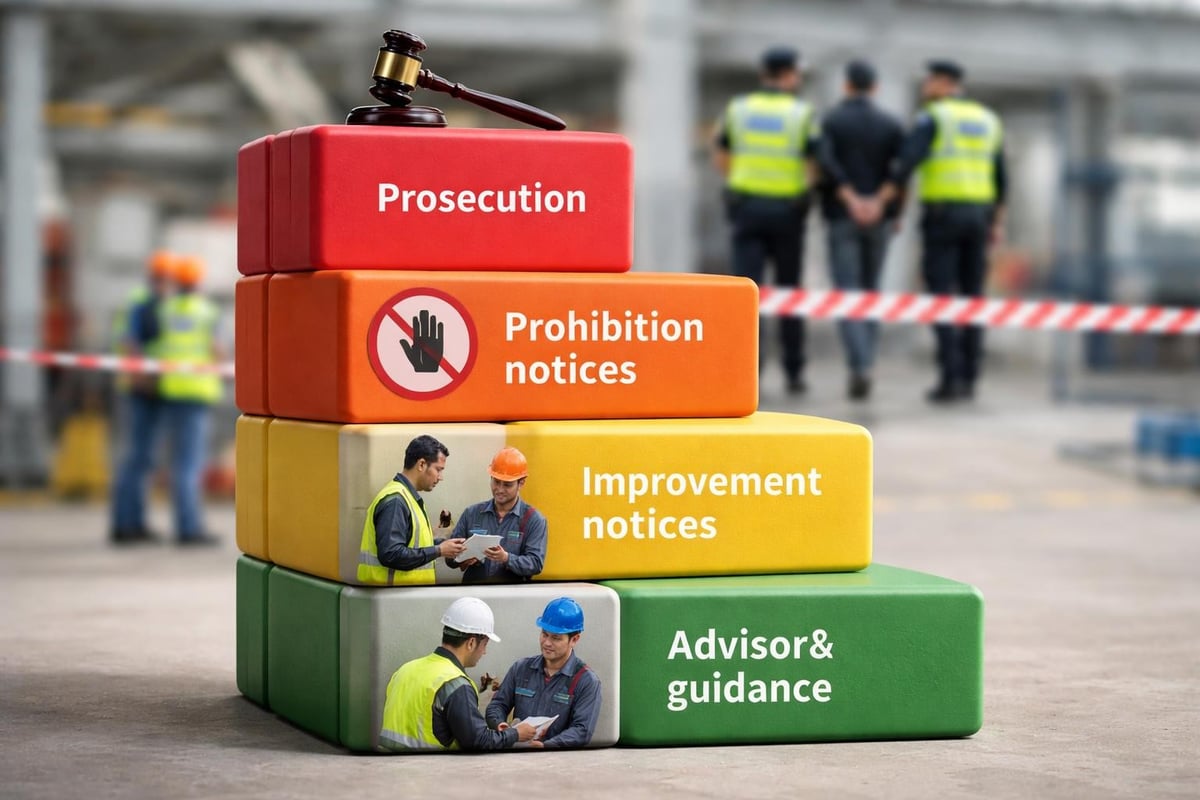
The Health and Safety Executive employs inspectors with extensive powers to enter premises, examine equipment, interview employees, and review documentation. These inspections may be routine, triggered by complaints, or follow incidents that suggest regulatory breaches.
When inspectors identify non-compliance with health and safety reg, they possess several enforcement tools:
Enforcement Action | Application | Consequences |
|---|---|---|
Improvement Notice | Specific breach requiring remediation within stated timeframe | Legal requirement to comply; failure leads to prosecution |
Prohibition Notice | Immediate danger requiring activity cessation | Immediate halt to dangerous operations until rectified |
Prosecution | Serious breaches or repeated non-compliance | Unlimited fines, imprisonment for directors, reputational damage |
Fee for Intervention | Recovery of HSE inspection and enforcement costs | Hourly charges for time spent addressing material breaches |
The fee for intervention scheme, introduced to encourage self-regulation, requires organisations found in material breach of health and safety reg to reimburse HSE costs. This financial mechanism reinforces the business case for proactive compliance.
Financial and Reputational Implications
Beyond direct enforcement actions, health and safety reg non-compliance carries substantial indirect costs. Insurance premiums increase when incident rates rise or compliance gaps emerge. Operational disruptions following prohibition notices impact productivity and customer relationships.
Perhaps most significantly, serious incidents attract media attention and public scrutiny. In the age of social media and instant communication, reputational damage spreads rapidly, affecting customer confidence, employee morale, and stakeholder relationships. The general duty clause principle, whilst originating in US legislation, reflects the universal expectation that employers maintain safe workplaces free from recognised hazards.
Corporate manslaughter legislation further raises the stakes for senior management, creating potential criminal liability when gross breaches of health and safety reg contribute to fatalities. Directors and senior officers can face personal prosecution when their conduct falls far below reasonable standards.
Documentation and Record-Keeping Requirements
Effective documentation forms an essential component of health and safety reg compliance, providing evidence of systematic risk management and supporting continuous improvement. Records serve multiple purposes, from demonstrating legal compliance during inspections to informing future decision-making and trending analysis.
Essential Documentation Categories
Comprehensive health and safety reg compliance requires maintaining several distinct categories of documentation:
Risk assessments and method statements: Documented evaluations of workplace hazards and the control measures implemented to manage them. These living documents require regular review and updating when conditions change.
Inspection and examination reports: Statutory records from thorough examinations of lifting equipment, pressure systems, and work equipment. These must be retained for specified periods and remain accessible for regulatory review.
Training records: Evidence that employees have received appropriate instruction, training, and supervision for their roles. This includes induction programmes, equipment-specific training, and refresher courses.
Accident and incident logs: Documentation of all workplace injuries, near-misses, and dangerous occurrences. RIDDOR (Reporting of Injuries, Diseases and Dangerous Occurrences Regulations) specifies reporting requirements for serious incidents.
Maintenance histories: Records of preventive and corrective maintenance activities, demonstrating equipment receives appropriate care throughout its service life.
The written scheme requirements under PSSR exemplify how health and safety reg mandates specific documentation formats for certain equipment categories, ensuring consistent approaches across different organisations and facilitating regulatory oversight.
Digital Documentation Systems
Modern technology offers significant advantages for health and safety reg documentation, replacing paper-based systems with digital platforms that enhance accessibility, searchability, and analysis capabilities. Cloud-based systems enable real-time updates, automated reminders for upcoming inspections, and comprehensive audit trails.
Benefits of digital documentation include:
Centralised storage: Single source of truth accessible across multiple locations
Automated workflows: Scheduled reminders for inspections, reviews, and renewals
Enhanced reporting: Trend analysis and performance dashboards supporting strategic decisions
Improved compliance: Reduced risk of missing critical deadlines or losing essential records
Stakeholder access: Controlled sharing with regulators, insurers, and competent persons
When implementing digital systems, organisations must ensure appropriate backup procedures, access controls, and data protection compliance. The transition from paper to digital documentation requires careful planning but delivers substantial long-term benefits for health and safety reg management.
Training and Competence Development
Health and safety reg places considerable emphasis on ensuring that individuals possess appropriate knowledge, skills, and experience for their roles. This competence requirement extends throughout organisations, from senior management to frontline operators, each requiring role-specific understanding.
Establishing Training Frameworks
Effective training programmes address three distinct levels of competence development:
Induction training: Basic health and safety awareness for all new employees, covering general workplace hazards, emergency procedures, and reporting obligations
Role-specific training: Targeted instruction for particular jobs or equipment types, ensuring operators understand both normal operation and foreseeable emergencies
Specialist development: Advanced training for individuals with safety-critical responsibilities, including competent persons conducting inspections or investigations
The framework should identify training needs systematically, considering both initial competence development and ongoing refresher requirements. Competence deteriorates without regular reinforcement, particularly for infrequently used skills or knowledge.
Training effectiveness depends not only on content quality but also on delivery methods suited to learner preferences and operational constraints. Blended approaches combining classroom instruction, practical demonstrations, and supervised practice typically deliver superior outcomes compared to single-method programmes.
Competence Verification and Assessment
Health and safety reg requires organisations to verify that training translates into demonstrated competence. Assessment methods vary depending on role complexity and risk level:
Practical demonstrations: Observed performance of safety-critical tasks under supervision
Knowledge tests: Written or oral examinations verifying understanding of procedures and principles
Workplace assessments: Evaluation of routine work performance against defined competence standards
Periodic reviews: Regular competence verification ensuring skills remain current
Documentation of competence assessments provides essential evidence during regulatory inspections and supports informed deployment decisions. The OSHA general safety references offer complementary perspectives on competence development that can inform UK training strategies.
Communication and Workplace Signage
Clear communication represents a fundamental element of health and safety reg, ensuring that hazards are recognised and understood by everyone who might encounter them. Standardised signage systems provide consistent visual communication across diverse workplace environments.
Safety Sign Categories and Applications
The Health and Safety (Safety Signs and Signals) Regulations 1996 established a standardised framework for workplace safety signage across the United Kingdom. This regulation harmonised UK practice with European standards, creating consistency that aids recognition and compliance.
Safety signs fall into distinct categories based on their purpose:
Prohibition signs (circular with red borders and cross-bars) forbid actions that would create danger, such as "No smoking" or "No unauthorised access".
Warning signs (triangular with yellow backgrounds) alert people to specific hazards like "Caution: Fork-lift trucks" or "Warning: Radiation area".
Mandatory signs (circular with blue backgrounds) indicate required actions such as "Wear ear protection" or "Safety helmets must be worn".
Emergency escape signs (rectangular green backgrounds) identify emergency exits, first aid facilities, and assembly points.
Fire equipment signs (rectangular red backgrounds) mark the location of fire-fighting equipment and alarm call points.
Effective signage under health and safety reg requires appropriate positioning, adequate illumination, and regular maintenance to ensure visibility and legibility. Signs supplement rather than replace training and other control measures, forming one layer within comprehensive risk management strategies.
International standards like ANSI Z535 demonstrate how different jurisdictions approach safety communication, though UK organisations must follow the specific requirements established in British health and safety reg.
Emerging Trends and Future Developments
Health and safety reg continues evolving in response to technological advancement, changing work patterns, and emerging understanding of occupational health risks. Forward-thinking organisations anticipate these developments, positioning themselves ahead of regulatory curves.
Technology Integration and Digital Transformation
The integration of technology into workplace safety management accelerates, driven by capabilities that were impractical or impossible with manual systems. Internet of Things (IoT) sensors enable real-time monitoring of equipment condition, environmental parameters, and worker locations, generating data streams that inform predictive maintenance and early hazard detection.
Artificial intelligence and machine learning algorithms analyse patterns within this data, identifying subtle trends that might escape human observation. Predictive analytics forecast equipment failures before they occur, enabling intervention during planned downtime rather than emergency response to breakdowns.
Virtual and augmented reality technologies transform training delivery, allowing workers to experience realistic hazard scenarios without actual risk exposure. These immersive learning environments accelerate competence development and improve retention compared to traditional classroom methods.
Mental Health and Psychosocial Risks
Growing recognition of mental health as a workplace health and safety reg consideration drives new approaches to risk assessment and control. Stress, burnout, and psychological harm increasingly feature in regulatory guidance and enforcement priorities, extending health and safety reg beyond traditional physical hazards.
Organisations must now consider:
Workload management: Ensuring reasonable demands and adequate resources
Organisational culture: Promoting respect, inclusion, and psychological safety
Support systems: Providing access to counselling and mental health resources
Work-life balance: Recognising the impact of working patterns on wellbeing
This broadened scope reflects modern understanding of workplace health, recognising that psychological harm can be equally serious as physical injury. Future health and safety reg developments will likely strengthen requirements in this area, particularly as remote and hybrid working patterns create new psychosocial risk profiles.
Climate Change Adaptation
Environmental changes driven by climate variation create emerging workplace hazards that health and safety reg must address. Increased frequency of extreme weather events, rising temperatures, and shifting disease patterns all impact workplace safety considerations.
Adaptation strategies include:
Heat stress management protocols for outdoor and non-air-conditioned environments
Enhanced flood risk assessments for facilities in vulnerable locations
Updated emergency response plans accounting for climate-related scenarios
Consideration of vector-borne disease risks in previously unaffected regions
Proactive organisations incorporate climate risk assessment into their broader health and safety reg frameworks, recognising that environmental changes will increasingly influence workplace hazard profiles throughout the coming decades.
Understanding and implementing health and safety reg requirements creates workplaces where people can perform their roles without unacceptable risk, whilst organisations maintain legal compliance and operational resilience. The regulatory framework, though complex, provides clear expectations and proven methodologies for systematic risk management across all industry sectors. For businesses seeking expert support with statutory inspection requirements, Workplace Inspection Services Ltd delivers nationwide, independent engineering inspections under LOLER, PUWER, PSSR, and COSHH regulations, helping organisations maintain compliance, reduce risk, and protect their most valuable asset-their people.