Health and Safety for Businesses: Essential Guide 2026
Health and Safety for Businesses: Essential Guide 2026

Managing workplace safety is no longer an optional consideration for organisations operating in the United Kingdom. Health and safety for businesses represents a fundamental responsibility that protects employees, reduces operational risks, and ensures compliance with an evolving landscape of statutory regulations. From manufacturing facilities to engineering workshops, every sector faces unique challenges that demand proactive safety management, comprehensive inspection regimes, and a culture that prioritises employee wellbeing. Understanding the legal framework, implementing effective control measures, and maintaining proper documentation forms the foundation of a robust safety system.
Understanding the Legal Framework for Workplace Safety
The Health and Safety at Work etc. Act 1974 establishes the cornerstone of workplace safety regulations in Britain, creating duties for employers to ensure the health, safety and welfare of their workforce so far as is reasonably practicable. This overarching legislation is supported by numerous regulations addressing specific hazards and equipment types.
Businesses must navigate multiple regulatory requirements depending on their operations. The Management of Health and Safety at Work Regulations 1999 mandate risk assessments and the implementation of preventive measures. Sector-specific regulations such as LOLER, PUWER, PSSR and COSHH create additional obligations for organisations using lifting equipment, work equipment, pressure systems or hazardous substances.

Compliance Obligations and Enforcement
The Health and Safety Executive (HSE) enforces workplace safety legislation through inspections, investigations and enforcement notices. Non-compliance carries serious consequences including:
Improvement notices requiring specific actions within set timeframes
Prohibition notices halting dangerous activities immediately
Unlimited fines for serious breaches prosecuted in Crown Court
Custodial sentences for directors and managers in severe cases
Reputational damage affecting client relationships and tender opportunities
Beyond regulatory penalties, businesses face civil liability claims from injured employees. Comprehensive workplace health and safety compliance protects organisations from both regulatory action and compensation claims whilst demonstrating duty of care.
Risk Assessment: The Foundation of Safety Management
Effective health and safety for businesses begins with thorough risk assessment. This systematic process identifies hazards, evaluates who might be harmed, and determines appropriate control measures. The HSE recommends a five-step approach that remains relevant across all industries.
Step 1: Identify the hazards
Walk through your workplace noting anything with potential to cause harm. Consider machinery, substances, work processes, environmental factors and human factors such as fatigue or inadequate training.
Step 2: Determine who might be harmed and how
Identify which groups of people face risks from each hazard. Consider employees, contractors, visitors, cleaners and maintenance personnel. Young workers, new starters, pregnant employees and those with disabilities may face heightened risks.
Step 3: Evaluate the risks and decide on precautions
Assess whether existing precautions are adequate or whether additional measures are needed. Apply the hierarchy of controls: elimination, substitution, engineering controls, administrative controls, and personal protective equipment.
Control Level | Description | Example |
|---|---|---|
Elimination | Remove the hazard entirely | Automate a manual handling task |
Substitution | Replace with something safer | Use water-based instead of solvent-based products |
Engineering Controls | Isolate people from hazards | Install machine guards or ventilation systems |
Administrative Controls | Change working methods | Implement permit-to-work systems or job rotation |
PPE | Protect the individual | Provide safety glasses, gloves or respiratory protection |
Step 4: Record your findings and implement them
Businesses with five or more employees must record significant findings. Documentation should identify hazards, affected persons, control measures, responsible individuals and review dates.
Step 5: Review and update regularly
Risk assessments require review when circumstances change-new equipment, different processes, after incidents, or annually as standard practice. OSHA's safety and health program guidelines provide additional frameworks for systematic review processes.
Equipment Safety and Statutory Inspections
Many workplace incidents involve equipment failure or improper use. Health and safety for businesses demands rigorous equipment management through proper selection, maintenance, inspection and operator training.
Work Equipment Regulations
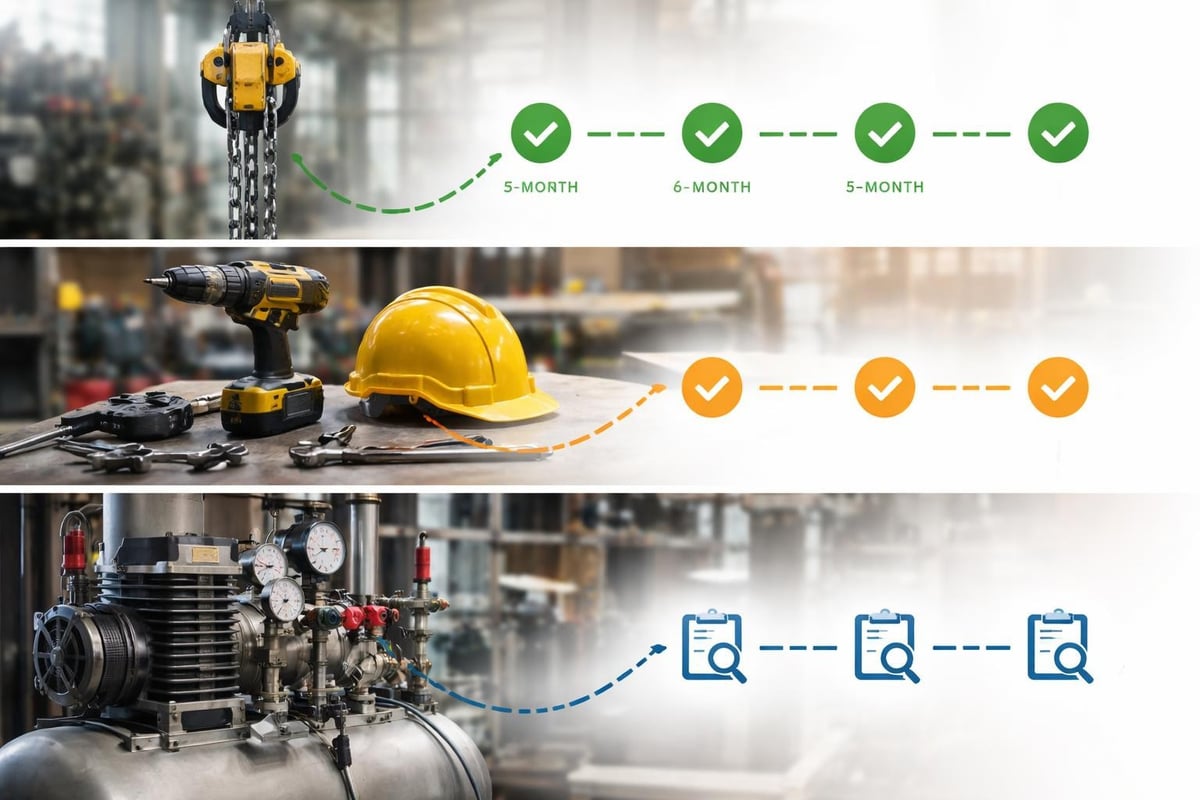
The Provision and Use of Work Equipment Regulations 1998 (PUWER) applies to virtually all equipment used at work, from hand tools to complex machinery. PUWER inspections verify that equipment is suitable, properly maintained, and used only by trained personnel with adequate information and instruction.
Key PUWER requirements include:
Equipment must be suitable for intended use and operating conditions
Maintenance logs must be kept demonstrating regular servicing
Dangerous parts of machinery require effective safeguarding
Controls must be clearly marked and easily accessible
Isolation from energy sources must be possible for maintenance work
Lifting Equipment Compliance
Lifting operations present significant risks requiring specialist attention. The Lifting Operations and Lifting Equipment Regulations 1998 (LOLER) mandate thorough examination of lifting equipment at specified intervals-typically six or twelve months depending on equipment type and use.
Competent persons must examine cranes, hoists, lifting accessories, passenger lifts and goods lifts to identify defects that could result in dangerous situations. Reports must detail any defects found and specify required remedial actions. Organisations can learn more about these requirements through resources on lifting equipment inspection protocols.
Pressure Systems Safety
Equipment operating under pressure-air receivers, steam boilers, pressure vessels and associated pipework-requires careful management under the Pressure Systems Safety Regulations 2000 (PSSR). These regulations mandate written schemes of examination prepared by competent persons, detailing inspection frequencies and critical examination points.
Creating a Safety Culture Through Employee Engagement
Technical compliance alone proves insufficient for effective workplace safety. Health and safety for businesses succeeds when organisations cultivate cultures where safety becomes a shared value rather than an imposed requirement.
Communication Strategies
Regular safety communications keep awareness high and reinforce key messages. Effective approaches include:
Toolbox talks: Brief, focused discussions before shifts addressing specific hazards or recent incidents
Safety notice boards: Visible displays showing policies, emergency procedures and performance metrics
Team meetings: Dedicated agenda items for safety discussions and employee feedback
Digital platforms: Email bulletins, intranet resources and mobile apps delivering timely information
The CDC's small business resource guide offers tailored communication templates and self-assessment tools particularly valuable for smaller organisations.
Training and Competence Development
Competent employees form the backbone of safe operations. Training programmes should address:
Induction training covering site-specific hazards, emergency procedures and reporting systems
Role-specific training for equipment operation, hazardous substance handling or specialist tasks
Refresher training at regular intervals ensuring knowledge retention
Supervisory training developing managers' abilities to identify risks and support safe behaviours
Emergency response training including first aid, fire safety and evacuation procedures
Maintaining training records demonstrates compliance and identifies gaps requiring attention. Certificates should specify training content, dates, trainers and validity periods.
Managing Specific Workplace Hazards
Different operations present distinct hazard profiles requiring tailored management approaches. Understanding sector-specific risks enables businesses to implement proportionate control measures.
Hazardous Substances
Substances hazardous to health include chemicals, dusts, fumes, vapours and biological agents. The Control of Substances Hazardous to Health Regulations (COSHH) require employers to prevent or adequately control exposure.
Assessment of substance risks considers exposure routes (inhalation, skin contact, ingestion), exposure duration, and vulnerable individuals. Control measures often involve ventilation systems requiring periodic examination to verify effectiveness. Regular health and safety inspections ensure these systems continue performing as designed.
Manual Handling and Ergonomics
Musculoskeletal disorders represent the most common cause of work-related ill health. Manual handling assessments evaluate lifting, carrying, pushing and pulling tasks to identify injury risks.
Risk Factor | Assessment Criteria | Control Options |
|---|---|---|
Load characteristics | Weight, size, stability, sharp edges | Reduce load size, improve packaging, use handles |
Task demands | Frequency, duration, postures required | Job rotation, mechanical aids, process redesign |
Working environment | Space constraints, floor surfaces, temperature | Improve layouts, maintain surfaces, climate control |
Individual capability | Physical capacity, training, health status | Match workers to tasks, provide training, health surveillance |
Ergonomic improvements-adjustable workstations, anti-fatigue matting, proper tool selection-reduce strain and improve productivity alongside safety outcomes.
Electrical Safety
Electrical equipment requires careful management through inspection, testing and maintenance regimes. Portable appliance testing (PAT), fixed installation inspections and residual current device (RCD) verification form components of comprehensive electrical safety programmes.
Incident Management and Continuous Improvement
Despite preventive measures, incidents occasionally occur. How businesses respond determines whether these events drive improvement or repeat themselves. Health and safety for businesses demands robust incident management processes that learn from failures.
Reporting and Investigation
The Reporting of Injuries, Diseases and Dangerous Occurrences Regulations 2013 (RIDDOR) require notification of serious incidents to the HSE. Reportable events include:
Deaths resulting from work activities
Specified injuries including fractures, amputations, serious burns and crush injuries
Injuries preventing normal work for more than seven consecutive days
Occupational diseases such as asbestosis, occupational dermatitis or work-related cancers
Dangerous occurrences with potential for serious harm even if no injury occurred
Internal reporting systems should capture near misses and minor incidents not meeting RIDDOR thresholds. These provide early warning of systemic problems before serious harm occurs.
Investigation Techniques
Effective investigations move beyond identifying immediate causes to uncover underlying systemic failures. The "5 Whys" technique drills down through superficial causes to root issues. For example:
Why did the employee fall? (They tripped on debris)
Why was debris present? (Housekeeping was inadequate)
Why was housekeeping inadequate? (No clear responsibility assigned)
Why was no responsibility assigned? (Process not included in procedures)
Why not included in procedures? (Risk assessment didn't identify housekeeping as control measure)
This reveals the true solution: updating risk assessments and procedures rather than simply blaming the individual who tripped.

Performance Monitoring
What gets measured gets managed. Safety performance indicators provide objective evidence of system effectiveness and improvement trends. Leading indicators measure proactive activities:
Risk assessments completed on schedule
Training compliance rates
Inspection completion percentages
Near miss reporting frequency
Safety observation completions
Lagging indicators track outcomes:
Lost time injury frequency rates
Days lost to workplace injuries
First aid incidents
Enforcement notices received
Insurance claims submitted
Balanced scorecards combining both indicator types provide comprehensive performance visibility supporting data-driven decision-making.
Documentation and Record Keeping Requirements
Comprehensive documentation proves essential for demonstrating compliance during HSE inspections and defending against civil claims. Health and safety for businesses requires systematic record management covering policies, assessments, inspections, training and incidents.
Essential Documentation
Document Type | Retention Period | Key Contents |
|---|---|---|
Health and safety policy | Current version + superseded versions | Responsibilities, arrangements, specific policies |
Risk assessments | Current + previous versions showing review history | Hazards identified, persons at risk, control measures |
COSHH assessments | 40 years for carcinogens, otherwise 3-5 years | Substance details, exposure routes, controls, monitoring |
Equipment inspection reports | Life of equipment plus 2 years | Examination findings, defects, remedial actions |
Training records | Duration of employment plus 6 years | Training content, dates, trainers, certificates |
Accident records | 3 years from incident date (longer for RIDDOR) | Incident details, investigations, corrective actions |
Health surveillance | 40 years from last entry | Medical examinations, exposure monitoring, fitness declarations |
Digital systems increasingly replace paper records, offering advantages in accessibility, backup and audit trails. However, businesses must ensure systems remain secure, regularly backed up and accessible to authorised personnel.
Audit and Review Processes
Regular audits verify that documented systems operate effectively in practice. Internal audits conducted quarterly or bi-annually examine:
Policy implementation and awareness
Risk assessment currency and adequacy
Control measure effectiveness
Training completion and competence
Inspection regime compliance
Incident management processes
External audits by independent specialists provide objective assessment and benchmarking against industry standards. Many organisations pursue certification to ISO 45001 (occupational health and safety management systems) demonstrating systematic approaches to safety management.
Resources such as The Home Depot's essential safety checklist offer practical frameworks for businesses developing comprehensive audit programmes.
Financial and Business Benefits of Safety Investment
Viewing health and safety for businesses purely as regulatory compliance misses significant commercial advantages. Effective safety management delivers measurable returns through reduced costs, improved productivity and enhanced reputation.
Direct Cost Reductions
Workplace incidents generate substantial direct costs:
Insurance premiums: Claims history directly impacts employer's liability and public liability premiums
Compensation payments: Even defended claims incur legal costs; successful claims result in substantial awards
Sick pay: Statutory and contractual sick pay for injured employees
Recruitment costs: Replacing employees lost through injury or ill health
Equipment damage: Incidents frequently damage plant, tools and materials
HSE research demonstrates that businesses implementing comprehensive safety programmes reduce incident rates by 20-40%, translating directly to lower insurance and compensation expenditure.
Productivity and Quality Improvements
Safe workplaces operate more efficiently. Benefits include:
Reduced absenteeism through fewer injuries and better morale
Lower staff turnover as employees value safety-conscious employers
Improved quality as careful, controlled processes reduce errors
Enhanced equipment uptime through proper maintenance and operation
Greater operational continuity without incident-related disruptions
Manufacturing facilities with strong safety cultures report productivity improvements of 5-15% compared to similar facilities with poor safety performance.
Reputation and Market Access
Corporate reputation increasingly depends on demonstrated social responsibility including workforce protection. Strong safety records provide competitive advantages:
Tender requirements: Major clients mandate safety certifications and audit evidence
Supply chain approval: Preferred supplier status often requires safety performance data
Insurance accessibility: Poor safety records may render some businesses uninsurable
Investor confidence: ESG (Environmental, Social, Governance) metrics influence investment decisions
Employee attraction: Skilled workers increasingly prioritise employer safety reputations
Organisations can strengthen their market position through visible commitment to safety compliance backed by independent verification.
Emergency Preparedness and Business Continuity
Comprehensive health and safety for businesses extends beyond preventing routine incidents to ensuring readiness for emergencies. Fire, chemical release, structural failure or medical emergencies require pre-planned responses enabling swift, coordinated action.
Emergency Planning Components
Effective emergency plans address:
Identification of potential emergencies relevant to the specific workplace
Clear alarm systems ensuring rapid notification throughout premises
Evacuation procedures with designated routes, assembly points and roll-call processes
Emergency roles including fire wardens, first aiders and incident coordinators
Communication protocols for notifying emergency services, management and stakeholders
Business continuity measures enabling operations to resume following incidents
Regular drills test plan effectiveness and familiarise personnel with procedures. Annual fire drills represent minimum requirements, with many organisations conducting more frequent exercises covering various scenarios.
First Aid Provision
The Health and Safety (First-Aid) Regulations 1981 require employers to provide adequate and appropriate first aid equipment, facilities and personnel. Needs assessment considers:
Workforce size and distribution across sites
Nature of work activities and associated injury risks
History of workplace accidents
Proximity to emergency medical services
Work patterns including shift work and lone working
First aid training must be delivered by HSE-approved organisations and renewed every three years. Maintaining current certificates and adequate coverage across all shifts and locations demonstrates regulatory compliance.
Prioritising health and safety for businesses protects your most valuable asset-your people-whilst simultaneously reducing operational risks and ensuring regulatory compliance. From understanding complex statutory requirements to implementing practical control measures and maintaining comprehensive documentation, every element contributes to safer, more productive operations. Workplace Inspection Services Ltd supports organisations across the United Kingdom with expert statutory inspections under LOLER, PUWER, PSSR and COSHH/LEV regulations, helping businesses maintain compliance, reduce risk and create genuinely safe working environments.