Workplace Safety and Health Regulations: A 2026 Guide
Workplace Safety and Health Regulations: A 2026 Guide

Workplace safety and health regulations form the foundation of every responsible business operation in the United Kingdom. These comprehensive legal frameworks protect employees, reduce operational risks, and establish clear standards for maintaining safe working environments. For businesses operating heavy machinery, lifting equipment, pressure systems, or hazardous substances, understanding and implementing these regulations isn't simply a legal obligation-it's a fundamental responsibility that directly impacts employee wellbeing, operational efficiency, and business continuity. As regulatory requirements evolve and enforcement becomes increasingly rigorous, organisations must stay informed about their statutory duties and implement robust compliance strategies.
Understanding the Legal Framework
The UK's approach to workplace safety and health regulations operates through a layered system of primary legislation, approved codes of practice, and industry-specific guidance. This framework establishes both general duties and sector-specific requirements that businesses must follow.
Primary Legislation and Enforcement
The Health and Safety at Work etc. Act 1974 serves as the cornerstone of British workplace safety law, establishing fundamental duties for employers, employees, and others. This legislation creates a general duty of care requiring businesses to ensure, so far as reasonably practicable, the health, safety, and welfare of all employees.
Key regulatory bodies include:
Health and Safety Executive (HSE) for most workplaces
Local authorities for retail, hospitality, and office environments
Specific regulators for high-risk industries
The enforcement approach combines proactive inspection programmes with reactive investigation of incidents and complaints. Regulatory bodies possess substantial powers, including improvement notices, prohibition notices, and prosecution capabilities. In 2026, enforcement has become more data-driven, with OSHA's laws and regulations framework serving as an international reference point for best practices in regulatory development.

Sector-Specific Regulations
Beyond general duties, workplace safety and health regulations encompass numerous sector-specific requirements addressing particular hazards and equipment types. These regulations create detailed obligations for businesses using specialised equipment or handling dangerous substances.
Regulation | Scope | Key Requirements |
|---|---|---|
LOLER 1998 | Lifting equipment and operations | Thorough examination, competent persons, safe systems |
PUWER 1998 | Work equipment provision and use | Suitability, maintenance, information, training |
PSSR 2000 | Pressure systems | Written schemes, examination, safe operating limits |
COSHH 2002 | Hazardous substances | Risk assessment, control measures, health surveillance |
Understanding inspection regulations specific to your industry helps businesses identify which statutory requirements apply to their operations and establish appropriate compliance schedules.
Risk Assessment and Management
Effective compliance with workplace safety and health regulations begins with comprehensive risk assessment. This systematic process identifies hazards, evaluates risks, and implements appropriate control measures to protect workers.
The Risk Assessment Process
Businesses must conduct suitable and sufficient risk assessments covering all work activities, equipment, and substances. This process examines who might be harmed, how harm could occur, and what measures already exist or should be implemented.
Identify hazards across all workplace areas and activities
Determine who might be harmed including employees, contractors, and visitors
Evaluate risks and existing control measures
Record findings and implement additional controls
Review assessments regularly and after significant changes
The hierarchy of control provides a systematic approach to risk reduction, prioritising elimination and substitution over personal protective equipment. Research on workplace accident patterns demonstrates how understanding systemic factors improves safety culture and reduces incident rates.
Documentation Requirements
Workplace safety and health regulations mandate comprehensive documentation demonstrating compliance. Businesses must maintain records of risk assessments, inspection reports, training records, and incident investigations. These documents serve multiple purposes: demonstrating due diligence, guiding operational procedures, and providing evidence during regulatory inspections.
Proper documentation also supports continuous improvement initiatives by identifying trends, highlighting recurring issues, and tracking the effectiveness of control measures over time.
Equipment Safety and Statutory Inspections
For businesses operating industrial equipment, statutory inspection requirements form a critical component of workplace safety and health regulations. These inspections verify equipment remains safe, fit for purpose, and compliant with legal standards.
Lifting Equipment Compliance
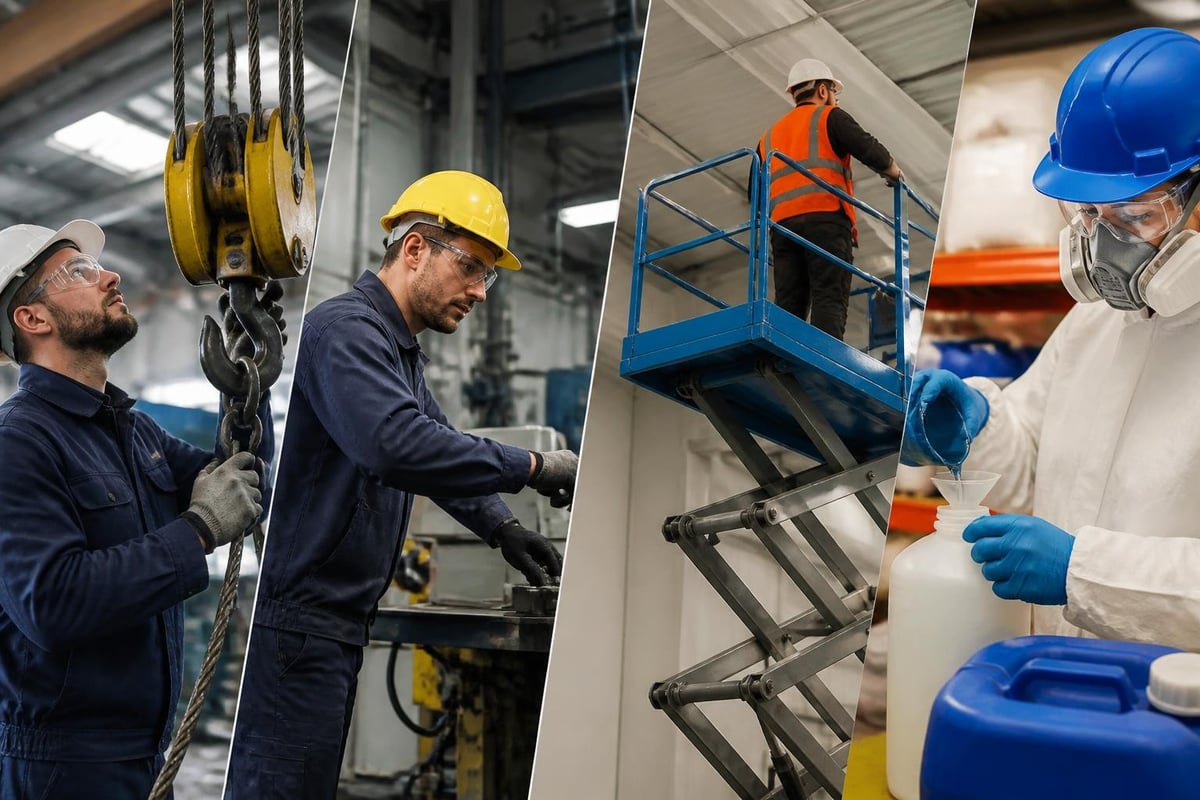
The Lifting Operations and Lifting Equipment Regulations 1998 establish comprehensive requirements for equipment used to lift loads. This includes cranes, hoists, lift trucks, lifting accessories, and other systems where equipment failure could result in serious injury.
LOLER requires:
Thorough examination by competent persons at specified intervals
Examination after installation and before first use
Investigation following exceptional circumstances
Maintenance of detailed inspection records
LOLER inspections ensure lifting equipment meets safety standards and identify deterioration before it creates dangerous conditions. Businesses must also ensure operators receive appropriate training and equipment is used only for its intended purpose within safe working loads.
Work Equipment Standards
PUWER establishes broad requirements for virtually all work equipment, from simple hand tools to complex manufacturing machinery. These workplace safety and health regulations require equipment to be suitable for intended use, maintained in safe condition, and operated by trained personnel.
Regular health and safety inspections help identify equipment degradation, improper modifications, or unsafe working practices before they result in incidents. Businesses should establish systematic inspection schedules based on equipment type, usage intensity, and manufacturer recommendations.
Hazardous Substances and Environmental Controls
Managing hazardous substances represents a significant aspect of workplace safety and health regulations for many industries. The Control of Substances Hazardous to Health Regulations create duties to prevent or adequately control employee exposure to substances that may cause harm.
COSHH Assessment and Control
Businesses must assess risks from hazardous substances including chemicals, fumes, dusts, vapours, and biological agents. This assessment informs the selection of appropriate control measures, typically emphasising engineering controls over personal protective equipment.
Local exhaust ventilation systems remove contaminants at source, preventing inhalation exposure. Regular LEV testing ensures these systems maintain adequate performance and comply with workplace safety and health regulations. The CDC's NIOSH recommendations provide evidence-based guidance on exposure limits and control strategies.
Businesses must also consider fire safety when handling hazardous substances, often requiring coordination with specialists such as Firesurv Group Ltd to ensure comprehensive protection strategies.
Health Surveillance
Where significant health risks remain after implementing controls, workplace safety and health regulations may require health surveillance programmes. These systematic health checks detect early signs of work-related illness, enabling intervention before serious harm occurs.
Training and Competency Requirements
Regulatory compliance depends fundamentally on workforce competency. Workplace safety and health regulations place clear duties on employers to provide adequate information, instruction, training, and supervision.
Essential Training Areas
Effective safety training addresses both general workplace risks and role-specific hazards. Training programmes should be:
Delivered before employees start work in new roles or with unfamiliar equipment
Refreshed regularly to maintain competency and update knowledge
Documented thoroughly with records of content, attendance, and assessment
Evaluated for effectiveness through observation and incident analysis
Training Type | Frequency | Content Focus |
|---|---|---|
Induction | Before starting | Site hazards, emergency procedures, reporting |
Equipment-specific | Before use, then periodic | Safe operation, maintenance, limitations |
Supervisory | Annual or biennial | Risk assessment, incident investigation, compliance |
Emergency response | Annual | Evacuation, first aid, incident management |
Understanding occupational safety requirements helps businesses develop comprehensive training programmes aligned with regulatory expectations and industry best practices.
Competent Person Appointments
Many workplace safety and health regulations require tasks to be performed by competent persons with appropriate training, knowledge, and experience. This applies particularly to risk assessments, equipment inspections, and safety-critical operations.
Businesses must carefully consider competency when appointing internal personnel or engaging external specialists. Competence encompasses theoretical knowledge, practical experience, and awareness of regulatory requirements and industry standards.
Incident Management and Reporting
When accidents occur despite preventive measures, workplace safety and health regulations establish clear requirements for investigation and reporting. These processes serve both regulatory compliance and organisational learning objectives.
RIDDOR Obligations
The Reporting of Injuries, Diseases and Dangerous Occurrences Regulations require businesses to report specified incidents to the enforcing authority. This includes fatalities, major injuries, over-seven-day injuries, occupational diseases, and dangerous occurrences.
Reportable incidents include:
Deaths resulting from work activities
Specified injuries such as fractures, amputations, and loss of sight
Injuries preventing normal work for over seven consecutive days
Diagnosed occupational diseases
Dangerous occurrences with serious potential consequences
Timely reporting enables regulatory investigation and contributes to national statistics informing policy development. The NIOSH regulatory agenda demonstrates how incident data shapes evidence-based safety improvements.
Internal Investigation Processes
Beyond statutory reporting, workplace safety and health regulations encourage thorough internal investigations to identify root causes and prevent recurrence. Effective investigations examine immediate causes, underlying factors, and systemic issues.
Investigation findings should inform risk assessment reviews, procedural improvements, and targeted training interventions. Organisations demonstrating robust investigation processes typically face more favourable regulatory outcomes following incidents.

Pressure Systems Compliance
Businesses operating pressure systems face specific obligations under workplace safety and health regulations designed to prevent catastrophic failures. The Pressure Systems Safety Regulations establish comprehensive requirements for safe design, operation, and maintenance.
Written Schemes of Examination
PSSR requires businesses to have written schemes prepared by competent persons, specifying which parts of pressure systems require examination and at what intervals. These schemes form the foundation of compliance programmes for air receivers, steam boilers, pressure vessels, and associated pipework.
Regular examinations verify pressure systems remain within safe operating parameters and identify deterioration requiring remedial action. Businesses must retain examination records and address defects according to timescales specified by examining engineers.
Emerging Technologies and Regulatory Adaptation
Workplace safety and health regulations continue evolving to address emerging risks and leverage new technologies. The integration of wearable technologies and connected-worker solutions demonstrates how innovation can enhance compliance and prevention.
Digital Compliance Tools
Modern businesses increasingly adopt digital platforms for managing inspections, training records, and risk assessments. These systems improve accessibility, enable trend analysis, and support audit readiness through centralised documentation.
Digital tools also facilitate real-time hazard reporting, automated compliance reminders, and data-driven safety performance monitoring. As workplace safety and health regulations embrace outcome-focused approaches, technology enables more sophisticated demonstration of effective risk management.
Maritime and Specialised Operations
Certain industries face additional regulatory layers beyond standard workplace requirements. Maritime operations, for example, must comply with federal safety regulations covering unique hazards associated with offshore activities.
Businesses operating across multiple regulatory jurisdictions must ensure comprehensive compliance programmes address all applicable requirements. Understanding how different regulatory frameworks interact helps prevent gaps in protection and demonstrates thorough due diligence.
Building a Compliance Culture
Sustainable compliance with workplace safety and health regulations extends beyond procedural adherence to encompass organisational culture and leadership commitment. Businesses demonstrating genuine safety commitment typically achieve superior outcomes in both regulatory compliance and operational performance.
Leadership Responsibilities
Senior management sets the tone for safety culture through resource allocation, visible commitment, and accountability structures. Effective leaders integrate safety into business strategy rather than treating it as a separate compliance function.
Leadership actions that strengthen compliance:
Allocating adequate resources for training, equipment, and inspections
Participating visibly in safety activities and communications
Establishing clear accountability for safety performance
Recognising and rewarding positive safety behaviours
Investigating and addressing systemic issues promptly
Organisations can strengthen their approach by consulting resources from industry compliance hubs that provide sector-specific guidance and best practice examples.
Worker Engagement
Workplace safety and health regulations recognise workers as valuable sources of safety knowledge and require meaningful consultation. Effective engagement mechanisms include safety committees, toolbox talks, suggestion schemes, and incident debriefings.
Workers directly involved with equipment and processes often identify practical improvements that might escape management attention. Creating psychologically safe environments where employees raise concerns without fear of reprisal strengthens overall safety performance.
Maintaining Long-Term Compliance
Regulatory compliance represents an ongoing commitment rather than a one-time achievement. Businesses must establish systematic processes ensuring continued adherence to workplace safety and health regulations despite organisational changes, equipment evolution, and regulatory updates.
Audit and Review Programmes
Regular internal audits verify compliance systems remain effective and identify improvement opportunities. These structured reviews should examine documentation, physical conditions, and behavioural aspects of safety management.
External audits by independent specialists provide objective assessment and benchmark performance against industry standards. Many businesses schedule audits to coincide with inspection frequency requirements, maximising efficiency whilst ensuring comprehensive coverage.
Audit Type | Frequency | Focus Areas |
|---|---|---|
Management system | Annual | Policies, procedures, responsibilities |
Compliance verification | Quarterly | Regulatory adherence, documentation |
Behavioural observation | Monthly | Safe working practices, training effectiveness |
Equipment condition | Per statutory schedule | Statutory inspections, maintenance records |
Continuous Improvement
Leading organisations treat workplace safety and health regulations as minimum standards rather than ultimate goals. Continuous improvement initiatives identify opportunities to enhance protection beyond baseline compliance.
Benchmarking against industry best practices, analysing near-miss data, and learning from incidents elsewhere help businesses anticipate and prevent problems. Resources such as federal workplace safety standards provide reference frameworks for developing robust safety management systems.
Workplace safety and health regulations establish essential protections that benefit employees, businesses, and society through reduced injuries, improved productivity, and sustainable operations. Maintaining compliance requires comprehensive understanding of applicable legislation, systematic implementation of control measures, and ongoing commitment to continuous improvement. Workplace Inspection Services Ltd supports organisations across the UK with expert statutory inspections under LOLER, PUWER, PSSR, and COSHH regulations, helping businesses maintain compliance, protect their workforce, and focus on core operations with confidence. Contact our specialist team to discuss how tailored inspection programmes can strengthen your compliance framework and reduce operational risk.