Occupational Safety Requirements: A Compliance Guide
Occupational Safety Requirements: A Compliance Guide

Understanding and implementing occupational safety requirements forms the cornerstone of responsible business management across the United Kingdom. These legal obligations extend far beyond simple compliance, creating frameworks that protect employees, reduce operational risks and establish systematic approaches to workplace hazards. For organisations operating machinery, lifting equipment or pressure systems, meeting statutory inspection requirements becomes a fundamental responsibility that requires expert knowledge and consistent application.
Understanding the Regulatory Framework
Occupational safety requirements in the UK operate under a comprehensive legislative structure designed to protect workers across all industries. The Health and Safety at Work Act 1974 provides the foundational framework, establishing employer duties and enforcement mechanisms that underpin specific regulations. Within this structure, businesses must navigate various statutory instruments that address particular risks and equipment types.
The regulatory landscape encompasses several key pieces of legislation:
Lifting Operations and Lifting Equipment Regulations 1998 (LOLER)
Provision and Use of Work Equipment Regulations 1998 (PUWER)
Pressure Systems Safety Regulations 2000 (PSSR)
Control of Substances Hazardous to Health Regulations 2002 (COSHH)
These regulations work in conjunction with European frameworks, particularly Directive 89/391/EEC, which established fundamental principles for improving worker safety across member states. Understanding how these requirements interconnect proves essential for comprehensive compliance programmes.

Statutory Inspection Obligations
Statutory inspections represent a core component of occupational safety requirements, mandating regular examinations of equipment and systems by competent persons. These inspections serve dual purposes: identifying deterioration or damage that could compromise safety, and verifying that equipment remains fit for purpose under its current operating conditions.
Different equipment categories require specific inspection frequencies. LOLER inspections must occur at intervals determined by risk assessment, typically six or twelve months for most lifting equipment, ensuring cranes, hoists and lifting accessories maintain their structural integrity and operational safety.
Regulation | Equipment Type | Typical Frequency | Key Focus Areas |
|---|---|---|---|
LOLER | Lifting equipment | 6-12 months | Load capacity, structural integrity, safety devices |
PUWER | Work machinery | Risk-based | Guarding, controls, maintenance condition |
PSSR | Pressure systems | Risk-based | Integrity, protective devices, examination scheme |
COSHH/LEV | Extraction systems | 14 months | Performance, airflow, effectiveness |
The inspection frequency guide provided by specialist services helps organisations establish appropriate examination schedules based on equipment usage, environmental conditions and risk profiles.
Risk Assessment and Documentation
Comprehensive risk assessments form the foundation of effective occupational safety requirements implementation. These assessments identify hazards, evaluate existing control measures and determine where additional safeguards prove necessary. The process requires systematic examination of work activities, considering both routine operations and foreseeable emergencies.
Documentation standards have evolved significantly with the adoption of ISO 45001, the international standard for occupational health and safety management systems. This framework emphasises continual improvement, worker participation and integration with broader business processes.
Effective documentation systems should include:
Hazard identification records showing systematic workplace examinations
Risk evaluation matrices quantifying likelihood and severity
Control measure hierarchies following elimination, substitution, engineering controls, administrative controls and PPE
Review schedules ensuring assessments remain current
Competent person appointments documenting qualifications and responsibilities
The written scheme requirements under PSSR exemplify how documentation supports ongoing safety management, establishing inspection parameters and defining examination scope for pressure systems.
Competent Person Requirements
Occupational safety requirements place particular emphasis on competent person appointments for statutory inspections and safety-critical functions. Competence encompasses not merely qualifications but practical experience, understanding of relevant standards and ability to recognise defects or deterioration.
The Health and Safety Executive defines competence through combined elements of training, experience and knowledge. For engineering inspections, this typically requires relevant qualifications in mechanical or electrical engineering, supplemented by specific training in inspection techniques and regulatory requirements.
Equipment-Specific Compliance Frameworks
Different equipment categories present unique challenges within occupational safety requirements. Manufacturing environments face particular complexity, requiring coordination across multiple regulatory frameworks simultaneously. Manufacturing facilities often operate lifting equipment, work machinery and pressure systems within integrated production lines, creating overlapping compliance obligations.
Lifting Equipment Management
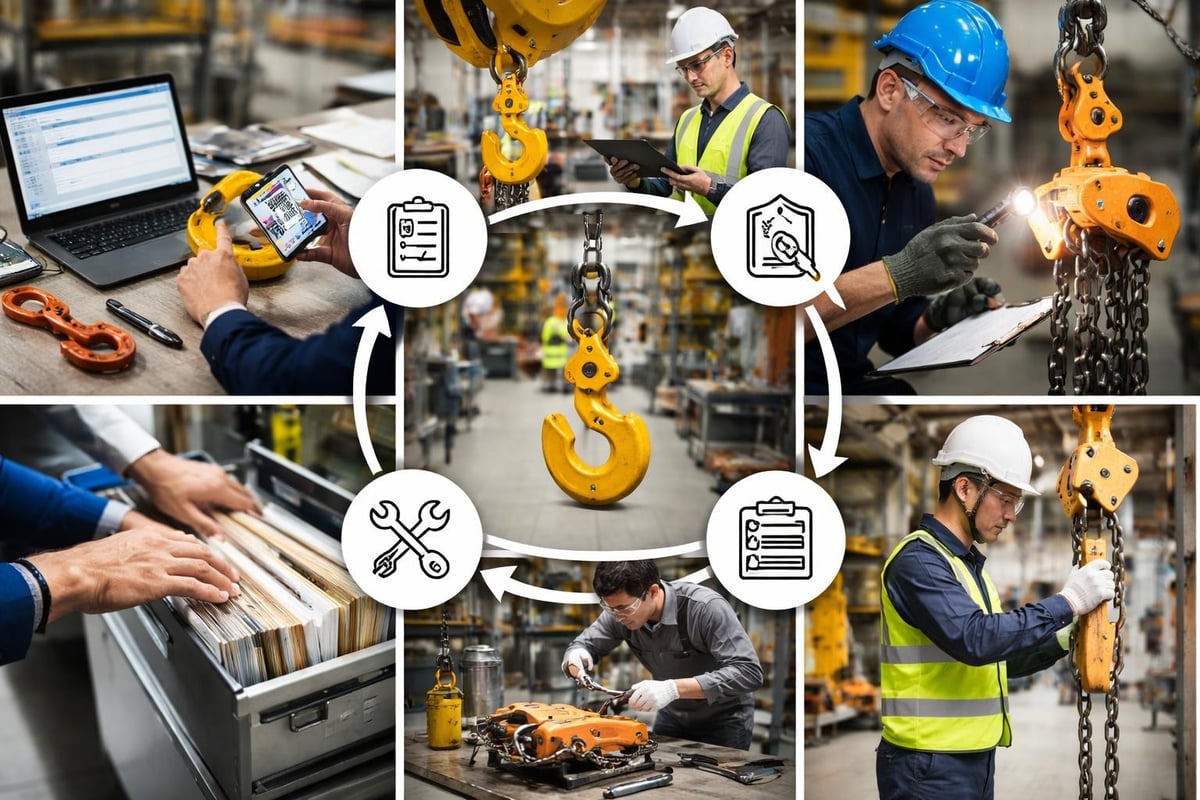
Lifting equipment safety extends beyond statutory examinations to encompass operational controls, operator training and thorough examination records. Organisations must maintain detailed registers of all lifting equipment, including unique identifiers, safe working loads and examination histories.
Pre-use checks complement formal inspections, with operators conducting daily visual examinations before commencing lifting operations. These checks identify obvious defects such as damaged slings, bent hooks or compromised structural components that could develop between statutory examinations.
Work Equipment Standards
PUWER establishes comprehensive occupational safety requirements for work equipment ranging from hand tools to complex manufacturing machinery. The regulations address equipment suitability, maintenance, inspection, guarding and operator information, creating holistic safety frameworks.
Key PUWER provisions include:
Suitability requirements ensuring equipment matches intended tasks
Maintenance obligations keeping equipment in efficient working order
Guarding standards protecting against dangerous parts
Control system specifications providing safe starting, stopping and emergency functions
Training mandates ensuring operators possess necessary skills
Understanding PUWER inspection requirements helps organisations establish appropriate examination intervals based on equipment type, usage intensity and operational environment.
Industry-Specific Applications
Occupational safety requirements manifest differently across industrial sectors, with specific hazards and equipment types demanding tailored approaches. Warehouse operations, for instance, concentrate heavily on lifting equipment, pallet racking and powered industrial trucks, whilst care homes focus primarily on patient hoists and mobility equipment.
High-Risk Sectors
Certain industries face elevated regulatory scrutiny due to inherent hazards. Fabrication workshops operate machinery presenting severe injury risks, requiring comprehensive guarding, operator training and regular safety inspections. Similarly, breweries manage pressure systems for fermentation and carbonation alongside lifting equipment and work machinery.
The aggregates industry exemplifies complex compliance environments where mobile plant, conveyor systems, crushing equipment and dust suppression systems create overlapping regulatory obligations. Effective compliance in these settings demands integrated management systems addressing multiple occupational safety requirements simultaneously.
Service Sector Considerations
Service industries face distinct compliance challenges despite lower equipment densities. Hotels and cafes must manage commercial kitchen equipment, goods lifts and potentially pressure systems for steam cleaning or cooking. Schools require particular attention to design technology equipment, maintenance access equipment and science laboratory fume extraction systems.
Understanding sector-specific risks enables proportionate application of occupational safety requirements without unnecessary administrative burden. The compliance hub provides sector-tailored guidance supporting targeted compliance approaches.
Inspection Planning and Scheduling
Systematic inspection planning ensures occupational safety requirements receive consistent attention within operational schedules. Effective planning balances statutory deadlines with operational needs, minimising production disruption whilst maintaining compliance standards.
Digital management systems increasingly support inspection scheduling, providing automated reminders, certificate tracking and compliance reporting. These systems help organisations manage equipment portfolios across multiple sites, ensuring no items exceed examination intervals.
Planning Element | Key Considerations | Implementation Tools |
|---|---|---|
Equipment registers | Complete asset lists with unique identifiers | Database systems, barcode tracking |
Frequency determination | Risk-based intervals aligned with regulations | Assessment matrices, competent advice |
Scheduling coordination | Production planning integration | Digital calendars, workflow systems |
Inspector availability | Competent person scheduling | Resource management systems |
Record management | Compliant documentation retention | Document management systems, cloud storage |
The inspection regulations overview clarifies statutory requirements across different equipment categories, supporting informed planning decisions.

Multi-Site Management
Organisations operating across multiple locations face additional complexity in meeting occupational safety requirements consistently. Centralised compliance management helps standardise approaches, share competent person resources and maintain corporate oversight of statutory obligations.
Best practices for multi-site compliance include:
Centralised equipment registers providing corporate visibility
Standardised inspection specifications ensuring consistent standards
Shared competent person resources optimising expertise deployment
Consolidated reporting systems supporting executive oversight
Inter-site auditing programmes verifying local implementation
Enforcement and Penalties
The Health and Safety Executive enforces occupational safety requirements through inspections, improvement notices, prohibition notices and prosecutions. Understanding enforcement approaches helps organisations prioritise compliance activities and recognise serious deficiencies requiring immediate attention.
HSE inspectors possess extensive powers to enter premises, examine equipment, interview employees and review documentation. Following inspections, they may issue improvement notices requiring specific actions within defined timescales, or prohibition notices immediately stopping dangerous activities.
Prosecution outcomes reflect offence severity, with unlimited fines available in Crown Courts for serious breaches. Recent cases demonstrate substantial penalties for companies failing basic occupational safety requirements, particularly where failures result in serious injury or fatalities.
Corporate Responsibilities
Director and officer liability extends beyond corporate penalties under certain circumstances. The Health and Safety at Work Act Section 37 enables prosecution of individuals where offences result from consent, connivance or neglect attributable to specific persons. This personal liability emphasises the importance of demonstrable senior management engagement with occupational safety requirements.
The general duty clause concept, whilst primarily associated with US legislation, reflects similar principles underlying UK employer duties to provide safe workplaces free from recognised hazards.
Maintaining Ongoing Compliance
Sustained compliance with occupational safety requirements demands systematic management approaches embedded within operational processes. Annual compliance reviews help organisations assess effectiveness, identify improvement opportunities and adapt to changing regulatory expectations.
Effective compliance programmes incorporate:
Regular management reviews assessing safety performance and compliance status
Internal audit programmes verifying local implementation of corporate standards
Competency development ensuring staff maintain current knowledge
Supplier management confirming contractor compliance with safety requirements
Incident investigation learning from near-misses and actual events
Resources from authoritative bodies support ongoing professional development. The OSHA reference texts provide foundational knowledge on industrial hygiene and occupational medicine, whilst the NIOSH authoritative recommendations offer evidence-based guidance on preventing workplace injuries and illnesses.
Technology Integration
Modern compliance management increasingly leverages technology to streamline processes and enhance oversight. Mobile inspection applications enable on-site documentation, photograph capture and immediate defect reporting. Cloud-based systems provide real-time compliance visibility across distributed operations.
Emerging technologies including IoT sensors offer predictive maintenance capabilities, identifying deterioration before failures occur. These approaches complement rather than replace statutory inspection requirements, providing additional safety margins through continuous monitoring.
Best Practice Development
Leading organisations view occupational safety requirements as minimum standards rather than compliance ceilings. Continuous improvement programmes seek enhanced safety outcomes through systematic learning, benchmarking and innovation.
Professional bodies and industry associations provide valuable forums for sharing best practices and emerging approaches. The OSHA additional resources directory connects practitioners with specialised information sources supporting advanced safety management.
Benchmarking against recognised standards such as ISO 45001, which replaced OHSAS 18001, helps organisations assess their safety management maturity and identify enhancement opportunities. These frameworks promote integration of safety considerations into strategic planning and operational decision-making.
Communication and Training
Effective communication ensures all personnel understand their roles in meeting occupational safety requirements. Training programmes should address both general safety awareness and role-specific competencies, with regular refreshers maintaining knowledge currency.
Visual communication standards such as the ANSI Z535 series demonstrate how standardised safety colours, signs and symbols enhance hazard recognition and promote consistent safety messaging across different operations and cultures.
Worker engagement strengthens compliance outcomes by incorporating frontline perspectives into risk assessments and control measure development. Consultation processes required under UK regulations create opportunities for collaborative safety improvement.
Record Retention and Evidence
Comprehensive record-keeping demonstrates compliance with occupational safety requirements whilst providing evidence of systematic safety management. Statutory inspection reports must be retained throughout equipment service life, with additional retention periods following disposal.
Organisations should maintain:
Inspection reports and certificates with competent person details
Risk assessments and review records
Training records demonstrating operator competency
Maintenance logs showing preventive and corrective actions
Incident reports and investigation findings
Management review minutes and action tracking
Digital systems simplify record management, providing searchable databases, automated retention schedules and secure backup capabilities. The supplementary testing services documentation exemplifies thorough record-keeping supporting comprehensive safety management.
Meeting occupational safety requirements protects both people and businesses through systematic risk management and regulatory compliance. Establishing robust inspection programmes, competent oversight and comprehensive documentation creates sustainable safety frameworks aligned with statutory obligations. Workplace Inspection Services Ltd supports UK businesses nationwide with expert statutory inspections under LOLER, PUWER, PSSR and COSHH/LEV regulations, helping organisations maintain compliance whilst reducing operational risks and ensuring safer working environments for all personnel.