Safety and Workplace: A Complete Compliance Guide
Safety and Workplace: A Complete Compliance Guide

Creating a secure working environment goes beyond meeting minimum legal requirements. For organisations across the UK, understanding the relationship between safety and workplace regulations determines not only compliance status but also the wellbeing of every person who enters the premises. From manufacturing facilities to commercial buildings, the intersection of engineering standards, statutory inspections and proactive risk management forms the foundation of operational excellence. This guide explores the critical components that make workplaces safer, more compliant and better equipped to protect their most valuable asset: their people.
Understanding the Regulatory Framework
The UK operates under a comprehensive set of regulations designed to protect workers from harm. These statutory requirements establish clear expectations for employers, setting minimum standards that must be maintained across all sectors.
The Health and Safety at Work Act 1974 serves as the primary legislation, placing a general duty of care on employers to ensure the health, safety and welfare of employees. Building upon this foundation, specific regulations address particular hazards and equipment types. Understanding workplace safety encompasses recognising how these regulations interact and complement each other to create a robust protective framework.
Key Statutory Inspection Requirements
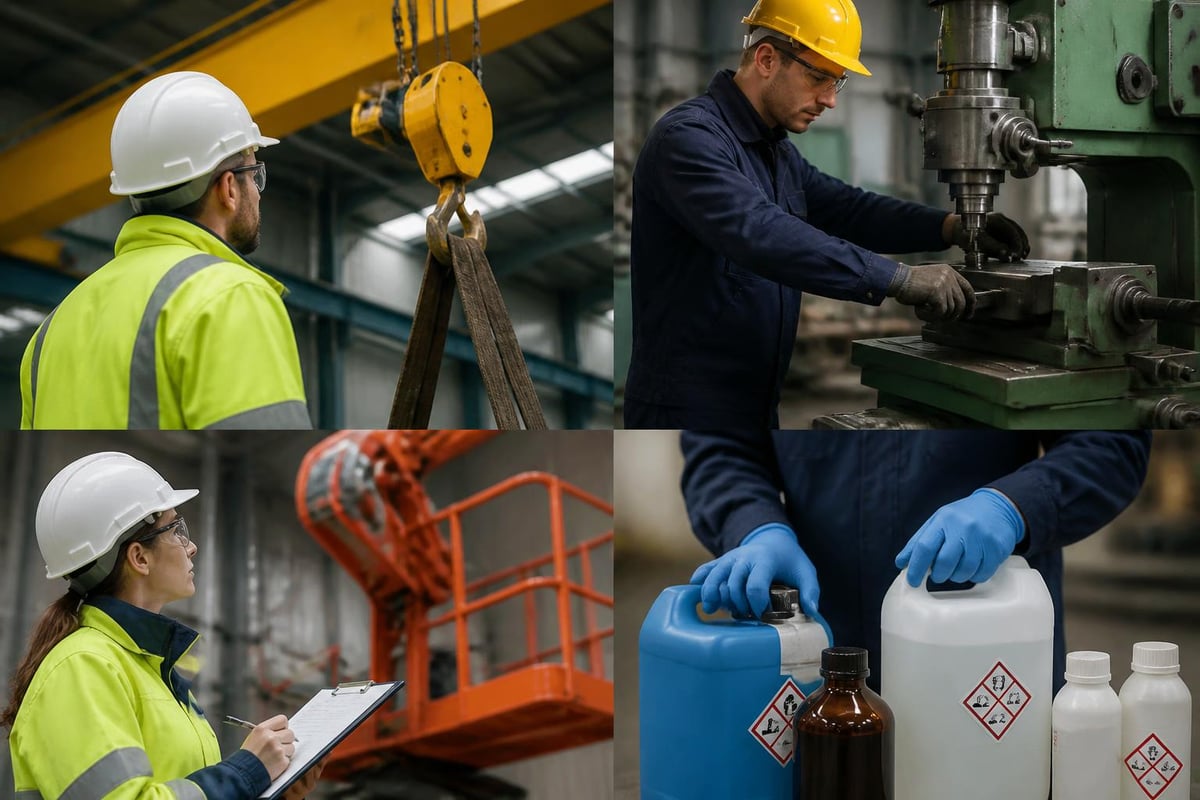
Different categories of workplace equipment require specialist examination by competent persons. This legal obligation ensures that potential failures are identified before they result in incidents.
Regulation | Equipment Covered | Primary Focus |
|---|---|---|
LOLER 1998 | Lifting equipment, cranes, hoists | Safe lifting operations |
PUWER 1998 | Work equipment, machinery | Equipment suitability and maintenance |
PSSR 2000 | Pressure systems, vessels | Pressure-related hazards |
COSHH 2002 | Hazardous substances, LEV systems | Exposure control |
Safety and workplace compliance requires businesses to maintain detailed records of all inspections, including examination reports, certification and any remedial actions taken. These documents provide evidence of due diligence and help organisations track equipment condition over time.
Risk Assessment and Hazard Identification
Effective safety and workplace management begins with systematic risk assessment. This process identifies potential dangers, evaluates their severity and implements appropriate control measures.
A structured approach involves five key steps:
Identify hazards present in the workplace environment
Determine who might be harmed and how exposure occurs
Evaluate existing controls and assess residual risk levels
Record findings and create an action plan for improvements
Review assessments regularly and after significant changes
Every workplace contains unique hazards based on industry, equipment and processes. Manufacturing environments might face machinery risks, whilst facilities handling chemicals must address exposure concerns. Workers' rights to workplace safety include protection from known hazards through proper risk management.
Common Workplace Hazards
Physical hazards represent immediate dangers that can cause injury through contact or exposure. These include unguarded machinery, electrical systems, noise exposure and manual handling tasks.
Mechanical risks from moving parts and powered equipment
Electrical dangers requiring proper isolation and protection systems
Thermal hazards from hot surfaces and extreme temperatures
Noise exposure causing long-term hearing damage
Chemical and biological hazards require different control strategies. Proper ventilation, containment and personal protective equipment become essential when workers handle hazardous substances. Safety and workplace protocols must address substance storage, handling procedures and emergency response.
Engineering Controls and Equipment Maintenance
Prevention through design represents the most effective approach to workplace safety. Engineering controls eliminate or reduce hazards at source, providing protection that doesn't rely on individual behaviour.
Machine guarding exemplifies this principle. Fixed guards prevent access to dangerous moving parts, whilst interlocked guards stop machinery when opened. These physical barriers create separation between workers and hazards, dramatically reducing injury risk.
Planned Preventative Maintenance
Regular maintenance prevents equipment deterioration and identifies developing faults before failure occurs. A structured programme includes daily operator checks, periodic servicing and comprehensive inspections.
Statutory inspections form a crucial component of this strategy. For example, LOLER inspections examine lifting equipment thoroughly, checking for wear, damage and compliance with safety standards. These examinations must be conducted by competent persons at intervals determined by risk assessment, typically six or twelve months.
Maintenance Level | Frequency | Performed By | Scope |
|---|---|---|---|
Operator checks | Daily | Equipment users | Visual inspection, basic function |
Routine service | Monthly/quarterly | Maintenance team | Lubrication, adjustment, wear checks |
Thorough examination | 6-12 months | Competent person | Comprehensive statutory inspection |
Major overhaul | As required | Specialist engineers | Complete strip-down and rebuild |
Documentation proves maintenance completion and tracks equipment history. Maintenance logs should record all work performed, parts replaced and any defects identified. This information supports decision-making about equipment replacement and helps investigators understand failures if incidents occur.

Training and Competency Development
Even the safest equipment becomes dangerous when operated by untrained personnel. Investment in comprehensive training programmes ensures workers understand hazards and apply safe working practices consistently.
Competency requirements vary by task complexity and risk level. Electrical safety training distinguishes between qualified persons who can work on live systems and unqualified persons who must maintain strict clearance distances. This differentiation reflects the serious consequences of electrical work performed incorrectly.
Structured Training Programmes
Effective training combines theoretical knowledge with practical application. Workers need to understand not just what to do, but why procedures exist and what consequences follow from deviation.
Induction training introduces new employees to site-specific hazards and general safety requirements. This foundational programme covers emergency procedures, personal protective equipment and basic risk awareness. Following induction, role-specific training addresses particular equipment and processes workers will encounter.
Equipment operation covering controls, limitations and emergency stops
Hazard recognition teaching workers to identify unsafe conditions
Safe working procedures for routine and non-routine tasks
Emergency response including evacuation, first aid and incident reporting
Refresher training maintains competency and updates knowledge when procedures change. Annual reviews help identify skill gaps and ensure workers remain current with evolving safety and workplace standards. Understanding inspection regulations helps personnel recognise when equipment requires statutory examination and understand the inspection process.
Creating a Positive Safety Culture
Technical controls and training provide essential protection, but organisational culture determines whether safety becomes embedded in daily operations or remains a checkbox exercise.
Leadership commitment sets the tone throughout the organisation. When senior managers visibly prioritise safety, allocate resources generously and hold themselves accountable, employees recognise genuine commitment. This cultural foundation encourages workers to raise concerns, report near-misses and suggest improvements without fear of negative consequences.
Worker Participation and Engagement
Safety and workplace excellence requires active participation from everyone. Consultation mechanisms give workers voice in decision-making about their own protection.
Safety committees bring together management and employee representatives to review incidents, discuss hazards and develop solutions collaboratively. Regular meetings ensure ongoing dialogue and demonstrate that worker input shapes safety strategy. Workers have the right to request safety inspections when they identify concerns, reinforcing that safety is a shared responsibility.
Suggestion schemes and near-miss reporting systems capture frontline knowledge. Workers often recognise hazards before they cause harm, but this intelligence only benefits the organisation if communication channels exist. Positive reinforcement for reporting, even when reports seem minor, encourages continued participation.
Monitoring and Continuous Improvement
Measuring safety performance provides objective evidence of programme effectiveness and highlights areas requiring attention. Leading indicators predict future performance, whilst lagging indicators measure actual outcomes.
Leading Indicators:
Inspection completion rates
Training hours delivered
Near-miss reports submitted
Safety observation tours conducted
Lagging Indicators:
Injury frequency rates
Lost time incidents
Equipment failures
Enforcement notices issued
Regular audits verify that safety systems function as designed. Key elements of workplace safety programmes include management leadership, worksite analysis, hazard prevention and safety training. Audits assess each component systematically, identifying gaps between policy and practice.
The Role of Independent Inspection
Whilst internal monitoring provides valuable oversight, independent verification offers objectivity and specialist expertise. External inspection companies bring fresh perspectives and deep technical knowledge to equipment examination.
Statutory inspections require competent persons who understand equipment design, operating principles and failure modes. These specialists identify subtle signs of deterioration that untrained observers might miss. Their independence from operational pressures ensures examination thoroughness and reporting integrity.
Inspection Type | Internal Capability | External Specialist |
|---|---|---|
Daily checks | ✓ Operator performed | Not required |
Routine maintenance | ✓ In-house team | Optional support |
Statutory thorough examination | Requires competent person | ✓ Independent verification |
Specialist testing | Limited capability | ✓ Specialist equipment and expertise |
Safety and workplace management benefits from establishing relationships with reputable inspection providers who understand sector-specific challenges. Consistent service from the same engineers builds knowledge of site equipment and history, improving defect detection and remediation advice.

Emergency Preparedness and Response
Despite best prevention efforts, emergencies occasionally occur. Preparedness determines whether incidents remain minor events or escalate into major disasters.
Emergency plans address foreseeable scenarios including fires, chemical releases, equipment failures and medical emergencies. These documents outline response procedures, assign responsibilities and identify resources required for effective management.
Essential Emergency Planning Elements
Evacuation procedures must account for all building occupants, including visitors and contractors who may be unfamiliar with exit routes. Clear signage, regular drills and designated assembly points ensure orderly evacuation under stressful conditions.
First aid provision scales with workforce size and workplace hazards. High-risk environments require more extensive medical support than standard office settings. Trained first aiders must be available during all working hours, with equipment accessible throughout the facility.
Communication systems enable rapid alerting and coordination during emergencies. Fire alarm systems, public address equipment and designated communication channels ensure information reaches everyone quickly. Alternative communication methods account for power failures or equipment damage.
Documentation and Record Keeping
Comprehensive records demonstrate compliance, support continuous improvement and provide evidence during investigations or legal proceedings. Safety and workplace documentation spans multiple categories, each serving specific purposes.
Inspection reports detail equipment condition, defects identified and recommendations for remediation. These documents must be retained for specified periods, often until the next inspection occurs. Certification confirms equipment meets safety standards and can be operated legally.
Training records prove competency and justify operator authorisation. Individual training files should include course content, assessment results and refresher dates. This documentation becomes critical if incidents occur involving trained personnel.
Incident investigations produce reports analysing what happened, why it occurred and how recurrence can be prevented. Root cause analysis looks beyond immediate triggers to identify systemic failures requiring correction. Thorough investigation findings drive meaningful improvement rather than superficial fixes.
Managing Contractors and Visitors
Sites hosting contractors and visitors must extend safety protection to these temporary occupants. Different knowledge levels and familiarity with site hazards require tailored control measures.
Contractor management begins during procurement. Safety criteria should influence supplier selection, ensuring contractors demonstrate strong safety performance and adequate insurance. Pre-work assessments identify specific hazards contractors will encounter and verify their competency to work safely.
Site induction for contractors covers emergency procedures, permit systems and site-specific rules. This orientation ensures visitors understand minimum safety requirements before accessing work areas. Ongoing supervision confirms compliance with agreed working methods.
Permit-to-work systems control high-risk activities including hot work, confined space entry and electrical isolation. These formal procedures ensure appropriate precautions are implemented and verified before hazardous work commences. Understanding compliance and safety procedures helps organisations implement effective control systems.
Establishing robust safety and workplace systems protects people whilst ensuring regulatory compliance across all operations. Success requires combining technical controls, competent inspections, comprehensive training and genuine cultural commitment to continuous improvement. Workplace Inspection Services Ltd supports organisations throughout the UK with expert statutory inspections covering LOLER, PUWER, PSSR and COSHH/LEV requirements, helping businesses maintain compliance, reduce risk and create safer working environments for everyone.