Health and Safety: Essential Standards for UK Workplaces
Health and Safety: Essential Standards for UK Workplaces

Health and safety remains the cornerstone of responsible business operations across the United Kingdom. Every organisation, regardless of size or sector, bears legal and moral responsibility for protecting employees, contractors, and visitors from workplace hazards. In engineering environments particularly, where heavy machinery, lifting equipment, and pressure systems operate daily, robust health and safety protocols aren't simply administrative requirements-they're essential safeguards that prevent injury, preserve life, and ensure operational continuity. Understanding the legislative framework, implementing effective control measures, and maintaining rigorous inspection schedules form the foundation of any successful workplace safety programme.
Understanding the Legal Framework for Workplace Safety
The UK's health and safety legislation creates comprehensive obligations for employers and duty holders. The Health and Safety Executive serves as the national regulator, enforcing standards and providing guidance across all industries. This regulatory environment establishes clear expectations for risk management, equipment maintenance, and employee protection.
Core Statutory Regulations
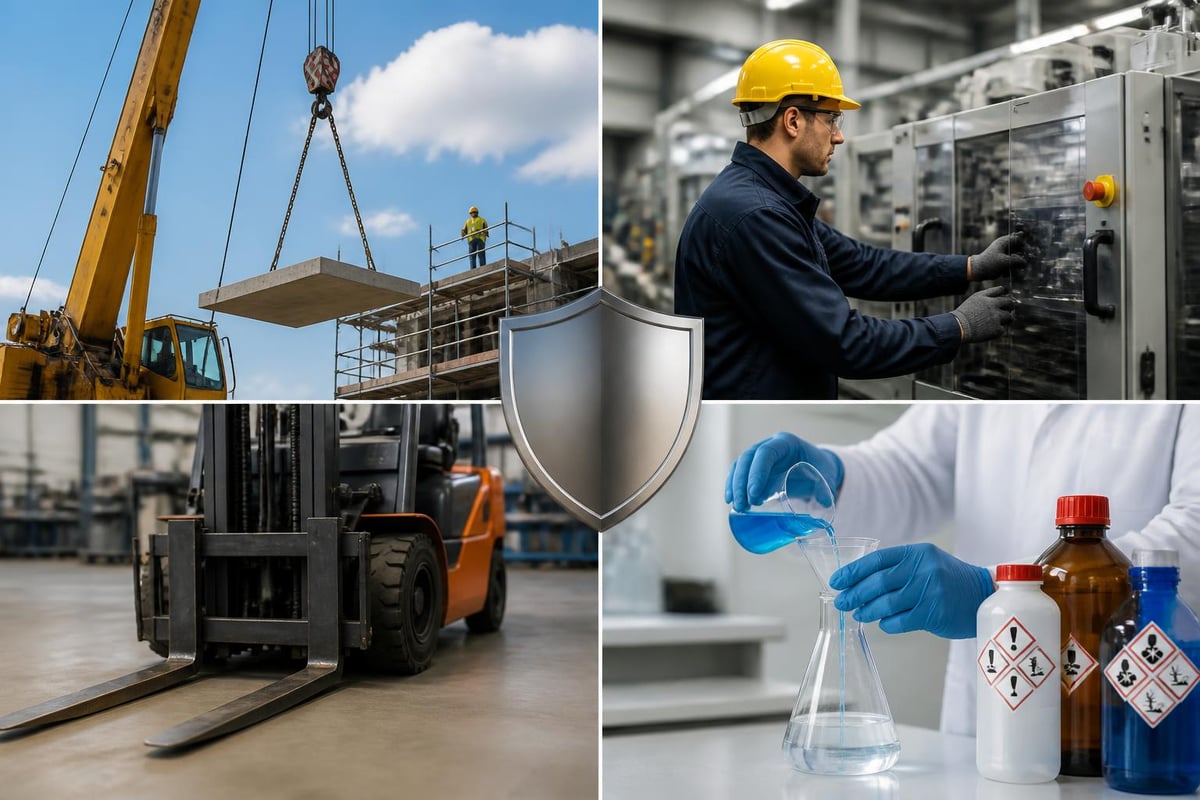
British law encompasses multiple regulations addressing specific workplace hazards. The Health and Safety at Work etc. Act 1974 provides the overarching framework, whilst specialised regulations target particular risks. LOLER governs lifting operations, PUWER addresses work equipment safety, and PSSR establishes requirements for pressure systems.
Key regulatory obligations include:
Conducting comprehensive risk assessments
Implementing appropriate control measures
Providing adequate training and supervision
Maintaining equipment to safe standards
Recording accidents and dangerous occurrences
Consulting with employees on safety matters
These requirements apply universally, though implementation varies according to workplace context. Manufacturing facilities face different challenges than office environments, whilst engineering workshops require specialised approaches to equipment safety.
The Duty Holder's Responsibilities
Responsibility for health and safety extends beyond designated safety officers. Directors, managers, supervisors, and individual employees each hold specific duties. Senior leadership must demonstrate commitment through resource allocation, policy development, and active engagement with safety initiatives.
Duty holders must ensure competent persons conduct statutory inspections at prescribed intervals. For organisations operating lifting equipment, LOLER inspections provide thorough examinations that identify defects, assess condition, and verify ongoing compliance with the Lifting Operations and Lifting Equipment Regulations 1998.
Risk Assessment: The Foundation of Health and Safety Management
Effective risk management begins with systematic identification and evaluation of workplace hazards. The risk assessment process examines what could cause harm, who might be affected, and whether existing precautions suffice. This analytical approach informs decision-making about control measures and resource allocation.
The Five-Step Assessment Process
Identify hazards: Walk through facilities, observe operations, review incident records, and consult employees
Determine who might be harmed: Consider employees, contractors, visitors, and vulnerable groups
Evaluate risks and implement controls: Assess likelihood and severity, then establish appropriate safeguards
Record findings: Document significant hazards, affected persons, and control measures
Review and update: Revisit assessments when circumstances change or incidents occur
Risk Level | Likelihood | Severity | Required Action |
|---|---|---|---|
Low | Unlikely | Minor | Monitor and maintain controls |
Medium | Possible | Moderate | Implement additional measures |
High | Likely | Serious | Immediate action required |
Very High | Certain | Fatal/Major | Stop activity until controlled |
This structured approach ensures nothing significant gets overlooked. Regular reviews maintain relevance as operations evolve, equipment ages, or processes change.
Implementing the Hierarchy of Controls
Once hazards are identified, organisations must implement control measures following established hierarchy principles. Elimination represents the most effective control, removing hazards entirely. When elimination proves impossible, substitution with less hazardous alternatives offers the next best option.
Engineering controls-physical modifications that reduce exposure-provide reliable protection without relying on human behaviour. Administrative controls and training supplement physical measures, whilst personal protective equipment serves as the final defence layer. Understanding inspection regulations helps organisations align their control strategies with statutory requirements.
Equipment Safety and Statutory Inspections
Engineering environments depend on mechanical equipment, lifting systems, and pressure vessels that require regular examination. Health and safety legislation mandates thorough inspections by competent persons at defined intervals. These examinations verify equipment remains fit for purpose, identify deterioration, and confirm ongoing safe operation.
Establishing Inspection Schedules
Inspection frequency depends on equipment type, usage intensity, and operating environment. Some items require examination every six months, whilst others need annual review. Inspection frequency guidance helps organisations establish compliant schedules tailored to their specific equipment portfolio.
Factors influencing inspection intervals:
Equipment classification and regulatory category
Manufacturer recommendations and design limitations
Operating conditions and environmental factors
Usage patterns and duty cycles
Previous examination findings and defect history
Maintaining accurate records demonstrates compliance and provides valuable data for maintenance planning. Documentation should include examination dates, findings, remedial actions, and the next due date.

The Role of Competent Persons
Regulations require examinations by competent persons possessing appropriate knowledge, training, and experience. This competence extends beyond technical skills to encompass understanding of relevant legislation, failure mechanisms, and safe examination procedures. Many organisations engage specialist inspection companies offering nationwide coverage and cross-sector expertise.
Independent engineering inspectors bring objectivity and specialist knowledge to examinations. Their detached perspective identifies issues that internal teams might overlook, whilst their broad experience across multiple sites provides valuable benchmarking insights. Organisations can explore comprehensive inspection services that cover multiple regulatory requirements.
Creating a Positive Safety Culture
Technical compliance alone doesn't guarantee workplace safety. Organisational culture-the shared values, beliefs, and behaviours regarding health and safety-fundamentally influences outcomes. Positive safety cultures treat protection as a core value rather than a compliance exercise.
Leadership and Visible Commitment
Senior management sets the cultural tone through their actions and priorities. When leaders actively engage with safety issues, allocate adequate resources, and respond constructively to concerns, employees recognise genuine commitment. Conversely, treating health and safety as administrative burden signals low priority.
Effective leadership involves regular workplace presence, meaningful dialogue with frontline staff, and willingness to address systemic issues. Directors should review safety performance metrics, participate in incident investigations, and champion continuous improvement initiatives.
Employee Engagement and Consultation
Workers possess invaluable knowledge about operational realities, near misses, and practical control measure effectiveness. Formal consultation mechanisms-safety committees, representative structures, and feedback systems-capture this insight. The Occupational Safety and Health Administration provides extensive resources on worker participation programmes.
Engagement extends beyond consultation to active involvement in hazard identification, risk assessment, and solution development. When employees contribute to safety improvements, they develop ownership and understanding that enhances compliance with established procedures.
Training, Competence, and Continuous Development
Health and safety competence requires ongoing development as regulations evolve, technology advances, and best practices emerge. Comprehensive training programmes ensure everyone understands their responsibilities, recognises hazards, and knows appropriate responses.
Structured Training Programmes
Training Type | Target Audience | Frequency | Content Focus |
|---|---|---|---|
Induction | New starters | Upon joining | Site hazards, emergency procedures, basic rules |
Role-specific | Equipment operators | As needed | Safe operation, maintenance, defect reporting |
Refresher | All employees | Annual | Policy updates, incident learning, procedural changes |
Specialist | Duty holders | As required | Advanced risk assessment, investigation techniques |
Training effectiveness depends on delivery methods matching learning objectives. Practical demonstrations suit equipment operation training, whilst classroom sessions work well for policy explanation. E-learning modules provide flexible access to information, though hands-on competencies require supervised practice.
Maintaining Records and Demonstrating Competence
Organisations must maintain training records proving employees have received appropriate instruction. These records should detail training dates, content covered, assessment results, and refresher schedules. During regulatory inspections or incident investigations, comprehensive training documentation demonstrates due diligence.
Competence extends beyond initial training to include supervised practice, ongoing assessment, and continuous professional development. For specialist roles-particularly those involving statutory duties-qualifications, experience, and currency of knowledge all contribute to competence determination.
Incident Management and Continuous Improvement
Despite preventive measures, incidents occasionally occur. Effective health and safety management requires robust response protocols that protect people, preserve evidence, and extract learning. The National Institute for Occupational Safety and Health develops evidence-based guidelines for incident investigation and prevention strategies.

Investigation and Root Cause Analysis
Thorough investigations move beyond identifying immediate causes to uncover underlying systemic factors. The '5 Whys' technique systematically explores causation chains, whilst fault tree analysis maps contributing factors. This deeper understanding enables interventions that prevent recurrence.
Essential investigation elements:
Immediate scene preservation and evidence collection
Witness interviews conducted promptly and sensitively
Timeline reconstruction establishing event sequence
Contributing factor identification across human, equipment, and organisational dimensions
Root cause determination distinguishing symptoms from underlying problems
Investigation findings should translate into actionable recommendations with assigned responsibilities and completion deadlines. Follow-up verification ensures recommendations are implemented effectively rather than simply documented.
Learning and Knowledge Sharing
Individual incident investigations generate valuable insights, but organisations multiply this value through effective knowledge sharing. Regular safety briefings communicate lessons learned, whilst case studies illustrate consequences of control failures. Some organisations maintain internal databases cataloguing incidents, investigations, and preventive measures.
Cross-industry learning amplifies improvement opportunities. Professional networks, trade associations, and regulatory guidance disseminate emerging risks and proven control strategies. Maintaining awareness of sector-wide safety developments ensures organisations benefit from collective experience. Resources like those available through the Canadian Centre for Occupational Health and Safety provide access to global safety literature and research findings.
Measuring Health and Safety Performance
Quantifying safety performance enables organisations to track progress, identify trends, and benchmark against standards. Effective measurement combines lagging indicators-outcomes that have occurred-with leading indicators that predict future performance.
Key Performance Indicators
Traditional metrics like injury rates and lost time accidents provide essential outcome data, but they only reveal performance retrospectively. Leading indicators offer predictive value by measuring proactive safety activities.
Balanced scorecard approach:
Outcome metrics: Injury frequency rate, accident severity rate, reportable incidents, enforcement notices
Activity metrics: Inspection completion rates, training delivery, risk assessment currency, near-miss reporting levels
Culture metrics: Safety observation participation, employee survey results, suggestion submission rates
Compliance metrics: Statutory examination currency, corrective action closure rates, audit findings
Regular reporting to leadership maintains visibility and accountability. Dashboard presentations make complex data accessible, whilst trend analysis highlights emerging issues requiring intervention.
Benchmarking and External Comparison
Internal performance tracking provides valuable longitudinal data, but external benchmarking offers context. Industry-specific benchmarks reveal whether performance matches sector norms or requires improvement. Some trade associations publish anonymised safety statistics enabling peer comparison.
Organisations should exercise caution when comparing raw statistics, as different operational contexts affect injury rates. A manufacturing facility naturally faces different risks than an office environment. Normalised metrics accounting for workforce size and hours worked enable fairer comparisons.
Technology and Innovation in Health and Safety
Digital technologies increasingly enhance safety management capabilities. Software platforms centralise documentation, automate reminders, and generate analytics. Mobile applications enable real-time hazard reporting and inspection recording. These tools improve efficiency whilst strengthening compliance.
Digital Inspection and Compliance Management
Modern inspection systems replace paper-based processes with digital workflows. Inspectors use tablets or smartphones to complete standardised checklists, capture photographs, and record measurements. Data synchronises automatically to central databases, ensuring immediate availability.
Benefits extend beyond convenience. Digital systems enforce completeness through mandatory fields, maintain audit trails showing who recorded what and when, and enable trend analysis across multiple examinations. Integration with maintenance systems ensures defects trigger work orders automatically. Organisations managing complex equipment portfolios can benefit from understanding supplementary testing services that complement statutory examinations.
Predictive Maintenance and Condition Monitoring
Advanced sensors continuously monitor equipment condition, detecting developing problems before failure occurs. Vibration analysis identifies bearing wear, thermography reveals electrical faults, and ultrasonic testing detects pressure system leaks. This predictive approach prevents breakdowns whilst optimising maintenance scheduling.
Integration of condition monitoring data with health and safety management systems creates powerful risk intelligence. Declining performance trends trigger early intervention, preventing hazardous failures. Some organisations employ artificial intelligence algorithms that learn normal operating patterns and flag anomalies requiring investigation.
Managing Contractor Safety
Many organisations employ contractors for specialist work, maintenance, or temporary projects. These arrangements create health and safety challenges requiring careful management. Contractors bring their own work methods and equipment whilst operating within the host organisation's environment.
Pre-Qualification and Selection
Effective contractor management begins during selection. Organisations should assess prospective contractors' safety competence, resources, and track record. Request evidence including safety policies, insurance certificates, training records, and previous performance data.
Assessment criteria should include:
Documented safety management systems
Relevant qualifications and accreditations
Insurance coverage meeting project requirements
Recent safety performance statistics
Client references and testimonials
This due diligence identifies capable contractors whilst screening out those with inadequate safety standards. Written agreements should clearly specify safety responsibilities, reporting requirements, and consequences of non-compliance.
Ongoing Monitoring and Communication
Once contractors commence work, active monitoring ensures standards are maintained. Regular site inspections verify compliance with agreed methods and identify emerging risks. Toolbox talks before high-risk activities ensure everyone understands hazards and controls.
Communication protocols should establish clear reporting channels for incidents, near misses, and unsafe conditions. Contractors must understand site-specific rules, emergency procedures, and key contacts. Integration with the host organisation's permit-to-work systems ensures hazardous activities receive appropriate authorisation and oversight. Understanding workplace regulations helps organisations establish comprehensive contractor management frameworks.
Emergency Preparedness and Business Continuity
Comprehensive health and safety management extends beyond normal operations to encompass emergency scenarios. Fires, chemical releases, structural failures, and security incidents all require planned responses. Effective emergency preparedness minimises harm, reduces property damage, and enables rapid recovery.
Emergency Response Planning
Emergency plans should address credible scenarios based on risk assessments. Manufacturing sites might prioritise fire and chemical incidents, whilst pressure system facilities emphasise explosion prevention. Plans must specify detection methods, alarm systems, evacuation procedures, and emergency communication.
Critical plan elements:
Clear command structure and decision-making authority
Defined assembly points and evacuation routes
Equipment shutdown procedures preventing escalation
Communication protocols for alerting emergency services
Accountability systems confirming everyone's safe
Recovery procedures enabling safe return to operations
Regular drills test plan effectiveness and maintain familiarity. Post-exercise debriefs identify improvement opportunities, ensuring plans evolve with operational changes.
Business Continuity Integration
Health and safety incidents can significantly disrupt operations. Major accidents might force facility closure, equipment failures can halt production, and regulatory enforcement could restrict activities. Business continuity planning addresses these scenarios, establishing alternative arrangements that maintain critical functions.
Integration between health and safety and business continuity teams ensures realistic planning. Understanding dependencies-which equipment is essential, which processes are critical-enables prioritised recovery efforts. Organisations can explore compliance hub resources that connect regulatory requirements with operational continuity.
Supply Chain Safety Management
Organisations increasingly recognise that health and safety responsibility extends beyond their immediate premises. Supply chain partners' safety performance affects product quality, delivery reliability, and reputational risk. Progressive organisations implement supplier safety assessment and development programmes.
Supplier Assessment and Audit
Supplier selection processes should incorporate safety evaluation alongside quality, cost, and delivery considerations. Request safety performance data, certification evidence, and incident statistics. Site audits verify suppliers maintain standards matching their documentation.
Assessment Area | Evaluation Criteria | Documentation Required |
|---|---|---|
Management Systems | Policies, procedures, responsibilities | Safety manual, organisation charts |
Performance Metrics | Injury rates, enforcement actions | Annual statistics, audit reports |
Competence | Training programmes, qualifications | Training matrices, certificates |
Legal Compliance | Regulatory adherence, certifications | Inspection reports, permits |
Audit findings should inform supplier selection decisions and ongoing relationship management. High-performing suppliers might receive preferential treatment, whilst underperformers face development requirements or replacement.
Collaborative Improvement Programmes
Rather than simply assessing suppliers, leading organisations actively support safety improvement. Knowledge sharing, joint training initiatives, and collaborative problem-solving strengthen overall supply chain performance. These partnerships create mutual benefits-suppliers improve safety whilst customers gain reliable, compliant partners.
Effective health and safety management requires sustained commitment, systematic approaches, and continuous improvement. By understanding regulatory obligations, implementing robust control measures, and fostering positive safety cultures, organisations protect their people whilst maintaining operational excellence. Workplace Inspection Services Ltd supports businesses across the UK with expert statutory inspections under LOLER, PUWER, PSSR and COSHH/LEV regulations, helping organisations maintain compliance, reduce risk and ensure safe working environments. Contact their nationwide team to discuss how professional engineering inspections can strengthen your health and safety programme.