Work Health Safety Legislation: A UK Compliance Guide
Work Health Safety Legislation: A UK Compliance Guide

Work health safety legislation forms the cornerstone of employee protection and workplace safety across the United Kingdom. For businesses operating in industrial, manufacturing, and engineering environments, understanding and complying with this complex regulatory framework is not simply a legal obligation but a fundamental responsibility to every person who enters their premises. The evolution of work health safety legislation over the past fifty years has created a comprehensive system designed to prevent accidents, reduce occupational illness, and ensure that employers take proactive measures to identify and control workplace hazards. This guide examines the key legislative requirements, employer responsibilities, and practical compliance strategies that organisations must implement to meet their statutory duties.
The Foundation of UK Work Health Safety Legislation
The Health and Safety at Work etc. Act 1974 remains the primary piece of work health safety legislation in the United Kingdom, establishing the legal framework upon which all subsequent regulations are built. This landmark Act introduced the principle that employers have a general duty of care to ensure, so far as is reasonably practicable, the health, safety and welfare of all their employees.
The Act's significance lies in its comprehensive scope, covering virtually every workplace and every work activity across the country. Employers must maintain safe systems of work, provide adequate training, ensure equipment is properly maintained, and consult with employees on safety matters. These fundamental requirements apply regardless of industry sector or business size.
Primary Legislative Duties
Under work health safety legislation, employers face several specific obligations that go beyond general duty of care principles:
Conducting suitable and sufficient risk assessments for all work activities
Implementing control measures to eliminate or reduce identified risks
Providing appropriate personal protective equipment where hazards cannot be eliminated
Establishing emergency procedures and evacuation arrangements
Maintaining accurate records of incidents, near misses, and occupational diseases
Appointing competent persons to assist with health and safety management
The Health and Safety Executive's legislative framework provides detailed guidance on how these duties translate into practical action across different workplace scenarios.

Sector-Specific Regulations and Compliance Requirements
Whilst the 1974 Act establishes general principles, work health safety legislation extends into numerous sector-specific regulations that address particular hazards and industries. For engineering and manufacturing environments, several regulations demand particular attention and rigorous compliance.
The Provision and Use of Work Equipment Regulations 1998 (PUWER) requires that equipment provided for use at work is suitable, properly maintained, and inspected at appropriate intervals. Organisations must ensure machinery is guarded effectively, operators receive adequate training, and maintenance activities follow safe systems of work. PUWER inspections form an essential component of compliance, verifying that workshop equipment, manufacturing machinery, and mechanical tools meet statutory safety standards.
Lifting Equipment and Pressure System Requirements
Regulation | Equipment Covered | Inspection Frequency | Key Requirements |
|---|---|---|---|
LOLER 1998 | Cranes, hoists, lifts, slings, chains | 6-12 months typically | Thorough examination by competent person |
PSSR 2000 | Air receivers, pressure vessels, steam systems | Based on written scheme | Written scheme of examination required |
PUWER 1998 | All work equipment and machinery | Risk-based intervals | Maintenance records and inspection logs |
The Lifting Operations and Lifting Equipment Regulations 1998 (LOLER) and Pressure Systems Safety Regulations 2000 (PSSR) represent critical elements of work health safety legislation for businesses using such equipment. These regulations mandate regular thorough examinations conducted by competent persons who can identify defects, deterioration, or circumstances likely to result in dangerous situations.
Understanding inspection regulations helps organisations establish appropriate examination schedules and maintain compliance with these specific requirements.
Hazardous Substances and Environmental Controls
Work health safety legislation addressing hazardous substances recognises that many industrial processes involve materials or create byproducts that pose significant health risks. The Control of Substances Hazardous to Health Regulations 2002 (COSHH) establishes a framework for managing these risks through assessment, control, monitoring, and health surveillance.
Employers must identify all hazardous substances present in their workplace, assess the health risks they pose, and implement appropriate control measures. This includes engineering controls such as local exhaust ventilation (LEV) systems that remove harmful dust, fumes, and vapours at source, preventing employee exposure to airborne contaminants.
Regular testing and examination of LEV systems ensures they continue to function effectively. Organisations must maintain records demonstrating system performance and compliance with work health safety legislation governing hazardous substance control.
Risk Assessment and Control Hierarchy
Work health safety legislation emphasises prevention over protection, requiring employers to follow a strict hierarchy when controlling workplace risks:
Elimination: Remove the hazard entirely from the workplace
Substitution: Replace hazardous substances or processes with safer alternatives
Engineering controls: Implement physical measures such as guards, enclosures, or ventilation
Administrative controls: Establish safe working procedures, training programmes, and rotation schedules
Personal protective equipment: Provide appropriate PPE as a last line of defence
This hierarchy ensures that organisations prioritise the most effective control measures, addressing risks at source rather than relying solely on worker behaviour or protective equipment.

Enforcement and Compliance Monitoring
The Health and Safety Executive (HSE) and local authorities serve as the primary enforcement bodies for work health safety legislation across the UK. These organisations conduct workplace inspections, investigate serious incidents, and possess powers to issue improvement notices, prohibition notices, and prosecute organisations failing to meet their statutory duties.
Legislation enforced by the HSE covers a vast range of workplace activities, with inspectors having authority to enter premises, examine documents, interview employees, and take samples or photographs. The consequences of non-compliance extend beyond regulatory sanctions, potentially resulting in significant financial penalties, reputational damage, and in serious cases, imprisonment of responsible individuals.
Proactive Compliance Strategies
Forward-thinking organisations recognise that compliance with work health safety legislation delivers benefits beyond avoiding enforcement action:
Reduced insurance premiums through demonstrated risk management
Improved productivity resulting from fewer accidents and reduced absenteeism
Enhanced employee morale when workers feel valued and protected
Competitive advantage when tendering for contracts requiring safety credentials
Legal defensibility if incidents occur despite reasonable precautions
Establishing robust safety and regulation frameworks positions organisations to meet current requirements whilst adapting to evolving legislative expectations.
International Perspectives and Comparative Frameworks
Whilst this article focuses on UK work health safety legislation, international frameworks provide valuable context and demonstrate global commitment to worker protection. The United States operates under the Occupational Safety and Health Act, with OSHA's laws and regulations establishing comparable employer duties and enforcement mechanisms.
The International Labour Organization's global database compiles occupational safety and health legislation from countries worldwide, facilitating comparative research and enabling organisations operating internationally to understand divergent regulatory expectations.
Common themes emerge across jurisdictions:
Employer duty of care as a fundamental principle
Risk assessment as the foundation of safety management
Competent person involvement in technical inspections
Worker consultation and participation requirements
Enforcement through inspection and prosecution powers
Competent Person Requirements and Technical Expertise
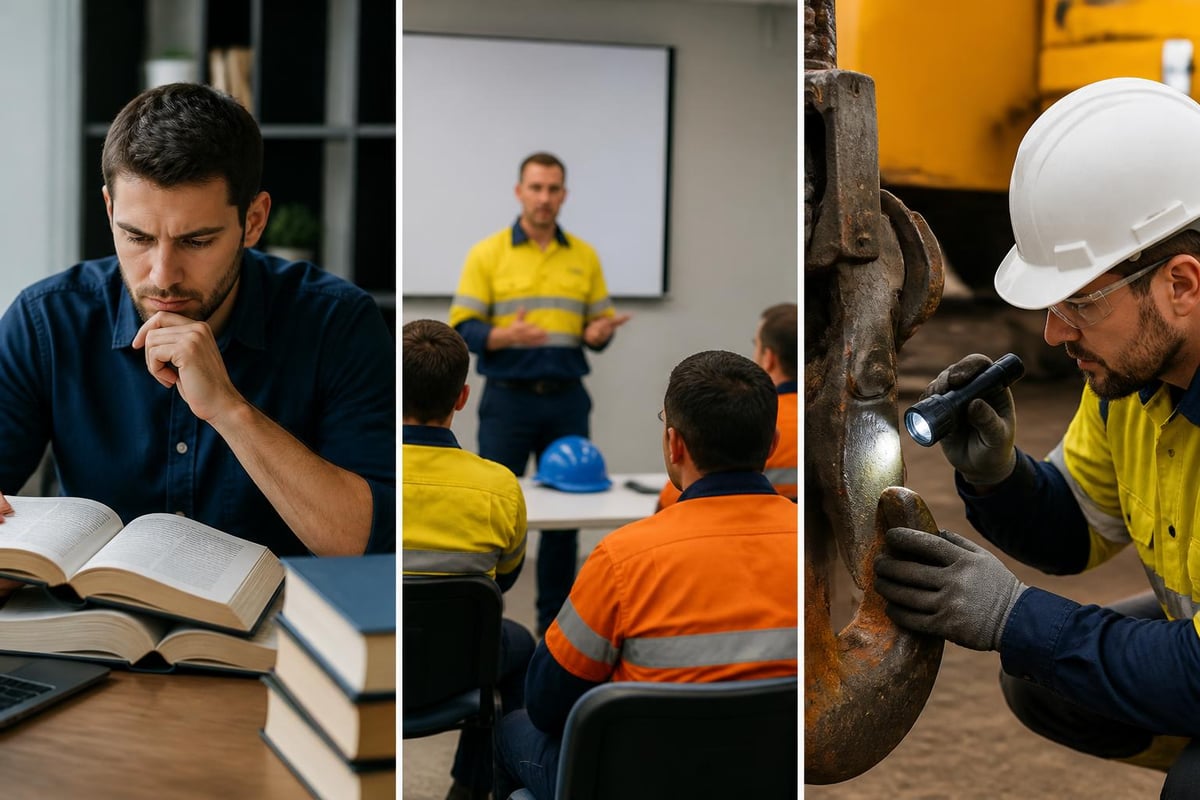
Work health safety legislation frequently references the concept of "competent persons" who possess the necessary knowledge, training, and experience to undertake specific safety-critical tasks. This requirement recognises that certain activities demand specialist expertise beyond general management capability.
For statutory inspections under LOLER, PUWER, and PSSR regulations, organisations must engage individuals or companies demonstrating appropriate competence. This includes understanding the equipment being examined, recognising potential defects or deterioration, and appreciating the safety implications of identified issues.
Demonstrating Competence
Competence encompasses three interrelated elements:
Knowledge: Understanding relevant legislation, technical standards, and engineering principles
Training: Formal qualifications and ongoing professional development
Experience: Practical exposure to equipment types and operational contexts
Many organisations engage independent inspection specialists who maintain competence through professional registration, manufacturer training, and regular practical involvement with diverse equipment and environments. Understanding health inspection requirements helps businesses select appropriately qualified providers.
Documentation and Record-Keeping Obligations
Work health safety legislation imposes extensive documentation requirements that serve multiple purposes: demonstrating compliance, supporting continuous improvement, and providing evidence should incidents occur or enforcement action commence. Employers must maintain comprehensive records covering risk assessments, inspection reports, training records, incident investigations, and monitoring data.
Document Type | Retention Period | Legislative Basis | Key Contents |
|---|---|---|---|
Risk assessments | Current + superseded versions | Health and Safety at Work Act 1974 | Hazards identified, persons at risk, controls implemented |
Thorough examination reports | Until next report, minimum 2 years | LOLER, PSSR | Equipment details, defects found, examiner recommendations |
Training records | Duration of employment + 6 years | Various regulations | Course content, dates, competence achieved |
Incident reports | 3 years minimum | RIDDOR | Circumstances, injuries sustained, immediate actions taken |
Effective documentation systems enable organisations to track compliance over time, identify recurring issues, and demonstrate due diligence. Digital record-keeping solutions increasingly replace paper-based systems, offering improved accessibility, searchability, and backup security.
Employee Consultation and Engagement
Work health safety legislation recognises that employees possess valuable insights into workplace risks and control measure effectiveness. The Safety Representatives and Safety Committees Regulations 1977 and Health and Safety (Consultation with Employees) Regulations 1996 establish frameworks for meaningful worker involvement in safety management.
Employers must consult employees on health and safety matters, either through appointed safety representatives or directly. This consultation should occur before introducing new equipment or processes, when planning training, and following incidents or near misses.
Benefits of Active Engagement
Organisations that embrace employee consultation beyond minimum compliance discover significant advantages:
Earlier identification of emerging risks through frontline observations
Greater acceptance of control measures developed collaboratively
Improved safety culture reflecting shared responsibility
Reduced likelihood of shortcuts or workarounds undermining controls
Enhanced regulatory credibility demonstrating genuine commitment
Regular safety committee meetings, toolbox talks, and suggestion schemes provide practical mechanisms for maintaining dialogue and ensuring work health safety legislation translates into meaningful workplace improvements.
Emerging Challenges and Legislative Evolution
Work health safety legislation continues evolving in response to changing workplace practices, emerging hazards, and technological developments. Recent years have seen increased attention to psychological health risks, including stress, bullying, and work-related mental health conditions. The COVID-19 pandemic demonstrated how work health safety legislation adapts to novel risks, with biological hazards requiring rapid assessment and control measure implementation.
Automation and robotics introduce new challenges as traditional guarding concepts prove inadequate for collaborative robots and autonomous systems. Work health safety legislation frameworks must accommodate these developments whilst maintaining fundamental protective principles.
Climate change implications increasingly feature in risk assessments, with extreme weather events, temperature increases, and changing disease patterns creating novel workplace hazards. Forward-looking organisations anticipate these trends, adapting their safety management systems proactively rather than reactively.
Digital Transformation and Safety Management
Technology offers opportunities to enhance compliance with work health safety legislation:
Mobile inspection applications streamlining data capture and report generation
IoT sensors providing real-time monitoring of equipment condition and environmental parameters
Predictive analytics identifying patterns suggesting increased risk
Virtual reality training simulating hazardous scenarios safely
Digital permitting systems controlling high-risk activities systematically
These tools supplement rather than replace fundamental compliance requirements, offering efficiency improvements whilst maintaining rigorous safety standards.
Training and Competency Development
Work health safety legislation places clear obligations on employers to ensure workers receive adequate training, instruction, and supervision appropriate to their roles. This extends beyond initial induction, requiring ongoing development as duties change, new equipment is introduced, or incidents reveal knowledge gaps.
Effective training programmes address three distinct levels:
Awareness training ensuring all employees understand general safety principles and their personal responsibilities
Task-specific training equipping workers to perform particular activities safely and competently
Specialist training developing expertise in complex or high-risk areas requiring detailed technical knowledge
Assessment and refresher training ensure competence is maintained over time, with organisations typically establishing maximum intervals between refresher courses based on role complexity and risk level.
Cost-Benefit Perspectives on Compliance
Some organisations perceive work health safety legislation compliance as a financial burden, viewing inspections, training, and control measures as costs without corresponding benefits. This perspective fundamentally misunderstands the economic case for robust safety management.
Research consistently demonstrates that effective safety programmes deliver positive financial returns through:
Reduced compensation costs from fewer injuries and occupational illnesses
Lower insurance premiums reflecting better risk profiles
Decreased business interruption when incidents don't halt operations
Avoided enforcement penalties and legal costs
Improved productivity as workers feel valued and protected
The true cost of non-compliance extends far beyond immediate fines, encompassing reputational damage, difficulty recruiting skilled workers, and potential director disqualification in serious cases. Viewing work health safety legislation compliance as an investment rather than a cost fundamentally shifts organisational approach and outcomes.
Navigating work health safety legislation requires sustained commitment, specialist knowledge, and systematic compliance frameworks that address both general duties and sector-specific requirements. Organisations that integrate safety into business operations, engage competent specialists, and foster genuine consultation create safer workplaces whilst meeting their legal obligations. Workplace Inspection Services Ltd supports businesses nationwide with expert statutory inspections under LOLER, PUWER, PSSR, and COSHH/LEV regulations, helping organisations maintain compliance, reduce risk, and ensure safe working environments across the UK.