Safety in the UK: Standards, Compliance & Best Practice
Safety in the UK: Standards, Compliance & Best Practice

Safety in the UK has evolved into a comprehensive framework of legislation, standards, and best practices designed to protect workers, consumers, and the public. From manufacturing facilities to construction sites, organisations must navigate a complex landscape of regulatory requirements that govern everything from product design to workplace operations. Understanding these safety obligations is essential for businesses operating in 2026, particularly those managing engineering equipment, machinery, and hazardous processes. The commitment to maintaining high safety standards not only fulfils legal duties but also protects business continuity, reduces insurance costs, and safeguards employee wellbeing.
The Legislative Foundation of Safety in the UK
The cornerstone of safety in the UK remains the Health and Safety at Work Act 1974, which established fundamental principles that continue to guide workplace safety today. This legislation places duties on employers to ensure, so far as is reasonably practicable, the health, safety, and welfare of their employees and others affected by their operations.
Understanding the legal framework is crucial for organisations seeking to maintain compliance. The Act is supported by numerous regulations covering specific risks and industries, creating a layered approach to safety management.

Key Regulatory Requirements
Modern businesses must comply with multiple sets of regulations depending on their operations:
LOLER 1998: Governs lifting equipment and operations
PUWER 1998: Covers general work equipment safety
PSSR 2000: Addresses pressure systems and vessels
COSHH 2002: Controls hazardous substance exposure
Management of Health and Safety at Work Regulations 1999: Requires risk assessments and safety management systems
The Health and Safety Executive (HSE) enforces these regulations and provides detailed statistics on workplace safety performance, helping organisations benchmark their safety standards against national trends.
Workplace Safety Standards Across Industries
Safety in the UK varies significantly across different sectors, with manufacturing, construction, and engineering facing distinct challenges. Engineering facilities typically manage risks associated with heavy machinery, lifting equipment, pressure systems, and hazardous substances, requiring rigorous inspection regimes and control measures.
Industry Sector | Primary Risks | Key Regulations | Inspection Focus |
|---|---|---|---|
Manufacturing | Machinery, noise, chemicals | PUWER, COSHH, LEV | Equipment guarding, ventilation |
Construction | Falls, struck by objects | CDM 2015, LOLER | Lifting equipment, scaffolding |
Engineering | Pressure systems, tools | PSSR, PUWER | Pressure vessels, workshop equipment |
Warehousing | Forklift operations, racking | LOLER, PUWER | Lifting accessories, materials handling |
Risk Assessment and Management
Effective safety management begins with comprehensive risk assessment. Organisations must identify hazards, evaluate risks, and implement appropriate control measures. This systematic approach forms the foundation of workplace health and safety compliance and demonstrates due diligence in legal proceedings.
Risk assessments should be:
Documented with clear records of findings and actions
Reviewed regularly or after significant changes
Communicated to all affected personnel
Implemented with adequate resources and training
Monitored to ensure controls remain effective
Statutory Inspection Requirements
One of the most critical aspects of safety in the UK involves mandatory inspections of workplace equipment and systems. These examinations ensure that machinery, lifting equipment, pressure systems, and other critical assets remain safe for continued use.
The inspection regulations establish clear requirements for examination frequency, competent person qualifications, and record-keeping obligations. Businesses must understand when equipment requires thorough examination, what constitutes a competent person, and how to maintain compliant documentation.
Lifting Equipment Compliance
LOLER establishes that lifting equipment must undergo thorough examination by a competent person at specified intervals. This includes cranes, hoists, lift trucks, lifting accessories, and any equipment used for lifting people or loads. Organisations operating such equipment must maintain detailed records and act promptly on any defects identified during LOLER inspections, which help identify wear, damage, or safety risks before they lead to incidents.
Typical LOLER examination intervals:
Equipment for lifting persons: 6 months
Lifting accessories: 6 or 12 months depending on use
Other lifting equipment: 12 months or according to examination scheme
Work Equipment Safety
PUWER requires that all work equipment is suitable for its intended use, properly maintained, and inspected where necessary to ensure ongoing safety. This encompasses an enormous range of equipment from hand tools to complex manufacturing machinery.
Businesses must ensure equipment is:
Suitable: Appropriate for the work and conditions
Maintained: In efficient working order through planned maintenance
Inspected: Subject to regular checks and thorough examinations
Guarded: Protected where necessary against dangerous parts
Controlled: Equipped with appropriate stop and emergency controls
Product Safety and Design Obligations
Safety in the UK extends beyond workplace operations to encompass product safety responsibilities. Manufacturers, importers, and distributors must ensure products meet essential safety requirements before placing them on the market.
UK product safety legislation requires that products are designed and constructed to be safe when properly used. This includes machinery, pressure equipment, electrical products, and personal protective equipment.

Manufacturer and Supplier Duties
Those who design, manufacture, import, or supply equipment for workplace use carry significant legal responsibilities. They must ensure products comply with relevant safety standards, provide adequate information and instructions, and conduct appropriate testing and certification.
The product liability framework establishes that businesses can be held liable for defective products that cause harm. This creates a strong incentive for thorough design reviews, quality control, and post-market monitoring.
Pressure System Safety
Pressure systems represent a significant hazard in many UK workplaces, requiring careful management under PSSR. These regulations apply to steam systems, air receivers, autoclaves, and other pressurised equipment capable of storing energy that could cause injury if released uncontrolled.
Safety in the UK for pressure systems demands:
Written schemes of examination prepared by competent persons
Periodic examinations at intervals specified in the scheme
Proper installation by competent personnel
Operating procedures that prevent dangerous situations
Maintenance systems ensuring continued safe operation
Organisations operating pressure systems must work with competent engineers to develop written schemes that identify critical components, specify examination requirements, and establish maximum safe operating limits.
Hazardous Substance Control
COSHH regulations form a crucial element of safety in the UK, protecting workers from exposure to substances hazardous to health. These include chemicals, fumes, dusts, vapours, mists, and biological agents encountered in many industrial processes.
Local Exhaust Ventilation
Where hazardous substances cannot be eliminated or substituted, engineering controls often provide the most effective protection. Local exhaust ventilation (LEV) systems capture contaminants at source, preventing worker exposure.
LEV systems require thorough examination and testing at least every 14 months to ensure they continue to perform effectively. Organisations must maintain records demonstrating system performance and promptly address any deficiencies identified during testing.
LEV examination includes:
Visual inspection of hoods, ducting, and fans
Airflow measurements at capture points
Static pressure readings across the system
Filter condition and contamination levels
Control system functionality
Safety Culture and Leadership
Technical compliance with regulations represents only part of achieving genuine safety in the UK workplaces. Organisations with strong safety performance typically demonstrate leadership commitment, employee engagement, and continuous improvement attitudes.
Cultural Element | Weak Safety Culture | Strong Safety Culture |
|---|---|---|
Leadership | Compliance-focused only | Visible, active commitment |
Communication | Top-down directives | Open dialogue, feedback loops |
Incident response | Blame individuals | Learn from events systemically |
Training | Minimum requirements | Ongoing development investment |
Worker involvement | Limited consultation | Active participation in decisions |
Competence and Training
Ensuring personnel possess appropriate competence is fundamental to workplace safety. This extends beyond initial training to encompass ongoing development, supervision, and verification that individuals can perform tasks safely.
Competence frameworks should address:
Knowledge: Understanding of risks and control measures
Skills: Practical ability to perform tasks safely
Experience: Exposure to relevant situations and scenarios
Behaviours: Attitudes and approaches to safety matters
Inspection and Enforcement
The HSE and local authorities enforce safety in the UK through inspections, investigations, and enforcement actions. Inspectors possess extensive powers to enter premises, examine documents, interview employees, and take samples or photographs.
Enforcement actions range from informal advice through to prosecution in serious cases. Understanding health and safety inspection processes helps organisations prepare for visits and respond appropriately to findings.
Common Enforcement Outcomes
Improvement notices require specific actions within a stated timeframe, typically 21 days or more. These address contraventions that need correction but don't pose immediate serious risk.
Prohibition notices immediately halt activities posing serious injury risk until specified remedial actions are completed. Failure to comply constitutes a criminal offence.
Prosecutions occur in cases of serious breaches, fatal incidents, or repeated non-compliance. Courts can impose unlimited fines and, in the most serious cases, imprisonment.
Industry-Specific Challenges
Different sectors face distinct safety challenges requiring tailored approaches. Engineering and manufacturing environments must manage machinery risks, while construction focuses on temporary works and changing site conditions.
Engineering Sector Priorities
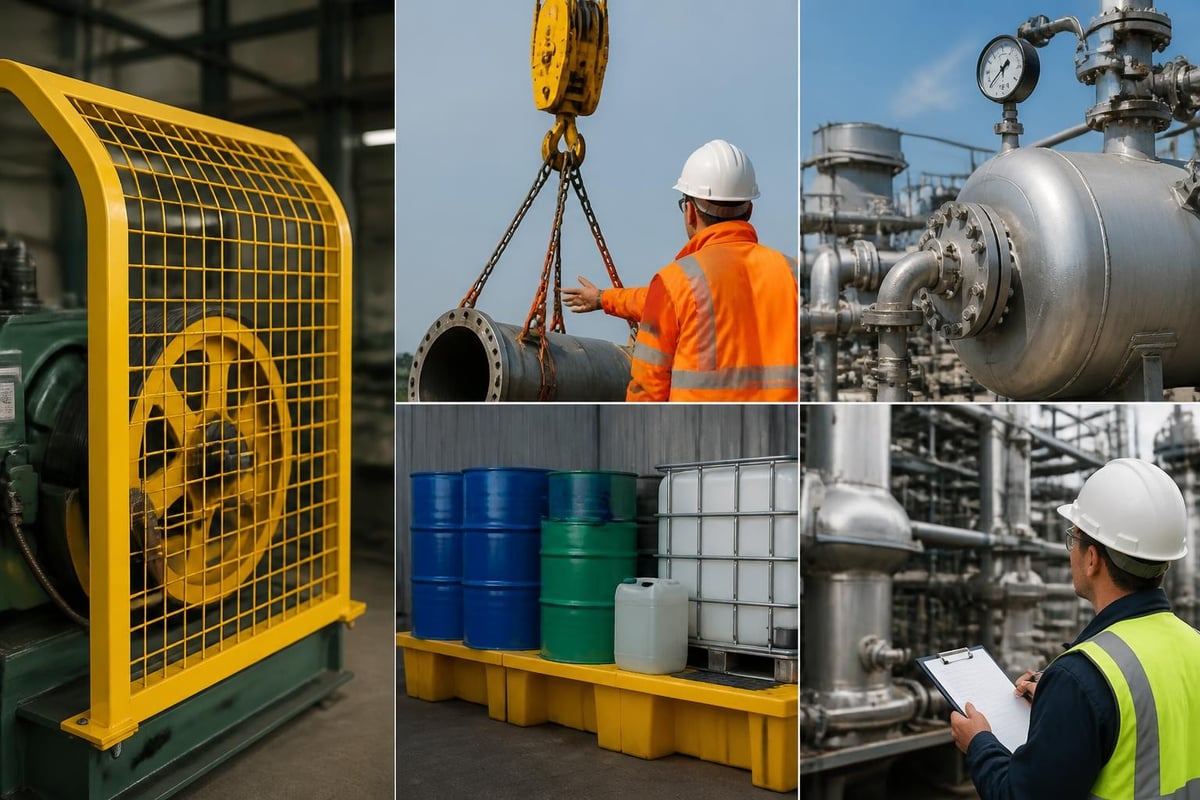
Engineering businesses managing workshops, fabrication facilities, and maintenance operations encounter multiple hazards requiring integrated control strategies. Safety in the UK engineering sector particularly emphasises:
Proper machine guarding and isolation procedures
Control of metal working fluids and welding fumes
Safe systems for working at height during installations
Electrical safety during equipment maintenance
Manual handling risk reduction through mechanical aids
These organisations benefit from working with specialist inspection providers who understand engineering inspection requirements and can deliver comprehensive examination services across multiple regulatory frameworks.
Documentation and Record-Keeping
Maintaining accurate records demonstrates compliance, supports incident investigations, and provides evidence of systematic safety management. Key documentation includes:
Risk assessments covering significant hazards
Inspection reports for statutory examinations
Training records showing competence development
Maintenance logs evidencing equipment upkeep
Incident records documenting events and investigations
Records should be retained for appropriate periods, typically at least three years for inspection reports, though some requirements specify longer retention. Digital systems increasingly replace paper records, offering improved accessibility and search functionality.
Emerging Safety Considerations
Safety in the UK continues to evolve as new technologies, working practices, and risks emerge. Current developments influencing safety management include:
Automation and robotics: Collaborative robots and automated systems introduce new human-machine interaction risks requiring updated risk assessments and safeguarding approaches.
Remote and hybrid working: Changing work patterns create different risk profiles, with organisations needing to address home working safety, mental health, and ergonomic considerations.
Digital safety: The Online Safety Act represents governmental recognition that safety extends beyond physical hazards into digital spaces.
Future Regulatory Developments
Post-Brexit, the UK retains discretion over safety standards while maintaining alignment with international best practice. Businesses should monitor regulatory developments and participate in consultations affecting their operations.
Industry-specific guidance helps organisations understand evolving requirements and implement compliant practices ahead of enforcement deadlines.
Measuring Safety Performance
Effective safety management requires measurement beyond simple injury statistics. Leading indicators provide insight into safety system effectiveness before incidents occur.
Lagging indicators include:
Injury frequency and severity rates
Lost time incident numbers
Reportable events under RIDDOR
Enforcement notices received
Leading indicators include:
Risk assessment completion rates
Training compliance percentages
Inspection findings and closure rates
Near-miss reporting levels
Safety observation participation
Organisations serious about safety in the UK track both types of metrics, using the data to drive continuous improvement and identify emerging risks before they result in harm.
Cost-Benefit Considerations
While safety compliance requires investment, the costs of failure far exceed prevention expenses. Workplace incidents result in direct costs (compensation, legal fees, increased insurance premiums) and indirect costs (lost productivity, reputational damage, employee morale impacts).
Cost Category | Incident Costs | Prevention Investment |
|---|---|---|
Direct financial | £10,000-£1,000,000+ | £2,000-£20,000 annually |
Business disruption | Days to months | Minimal with planning |
Reputation impact | Long-term damage | Enhanced standing |
Insurance premiums | Significant increases | Potential reductions |
The HSE's general statistics publication demonstrates the substantial economic burden workplace incidents place on UK businesses, with work-related ill health and injury costing society over £20 billion annually.
Selecting Competent Inspection Providers
Organisations requiring statutory examinations must engage competent persons possessing appropriate qualifications, experience, and knowledge. When selecting inspection providers, businesses should verify:
Accreditation: Recognition by relevant professional bodies
Experience: Track record in relevant equipment types and industries
Independence: Freedom from conflicts of interest
Insurance: Adequate professional indemnity coverage
Reporting: Clear, actionable examination reports
Independent specialists offer objectivity and breadth of experience across different sites and equipment configurations, helping organisations identify issues that internal personnel might overlook.
Maintaining safety in the UK requires ongoing commitment to compliance, continuous improvement, and engagement with evolving best practices across multiple regulatory frameworks. Whether managing lifting equipment, pressure systems, machinery, or hazardous substances, organisations benefit from partnering with experienced professionals who understand the complexities of statutory requirements. Workplace Inspection Services Ltd delivers expert engineering inspections under LOLER, PUWER, PSSR, and COSHH/LEV regulations, helping businesses nationwide maintain compliance, reduce operational risks, and protect their most valuable asset: their people.