PUWER Equipment: Essential Compliance and Safety Guide
PUWER Equipment: Essential Compliance and Safety Guide

Understanding the legal requirements surrounding work equipment is fundamental to maintaining a safe workplace and meeting statutory obligations. The Provision and Use of Work Equipment Regulations 1998 (PUWER) establishes a comprehensive framework governing how businesses must manage, maintain, and inspect machinery and equipment across all industries. Whether you operate a manufacturing facility, warehouse, workshop, or office environment, puwer equipment regulations apply to virtually every piece of machinery and tools used during work activities. From simple hand tools to complex industrial machinery, these regulations ensure that equipment remains safe, fit for purpose, and properly maintained throughout its operational life.
What Constitutes PUWER Equipment
The scope of puwer equipment extends far beyond heavy industrial machinery. The regulations encompass an extraordinarily broad range of work equipment used across different sectors and workplace environments.
Defining Work Equipment Under PUWER
Work equipment includes any machinery, appliance, apparatus, tool, or installation used at work. This definition captures everything from basic hand tools and ladders through to sophisticated manufacturing equipment, processing machinery, and automated systems. PUWER regulations apply regardless of the equipment's age, condition, or complexity.
The regulations cover:
Hand-held tools including power drills, grinders, and cutting equipment
Processing machinery such as lathes, milling machines, and CNC equipment
Materials handling equipment including conveyors, pallet trucks, and packaging machinery
Workshop equipment like bench-mounted tools, presses, and welding apparatus
Office equipment when it poses potential safety risks
Agricultural machinery used in farming and forestry operations
Construction equipment including excavators, compactors, and concrete equipment
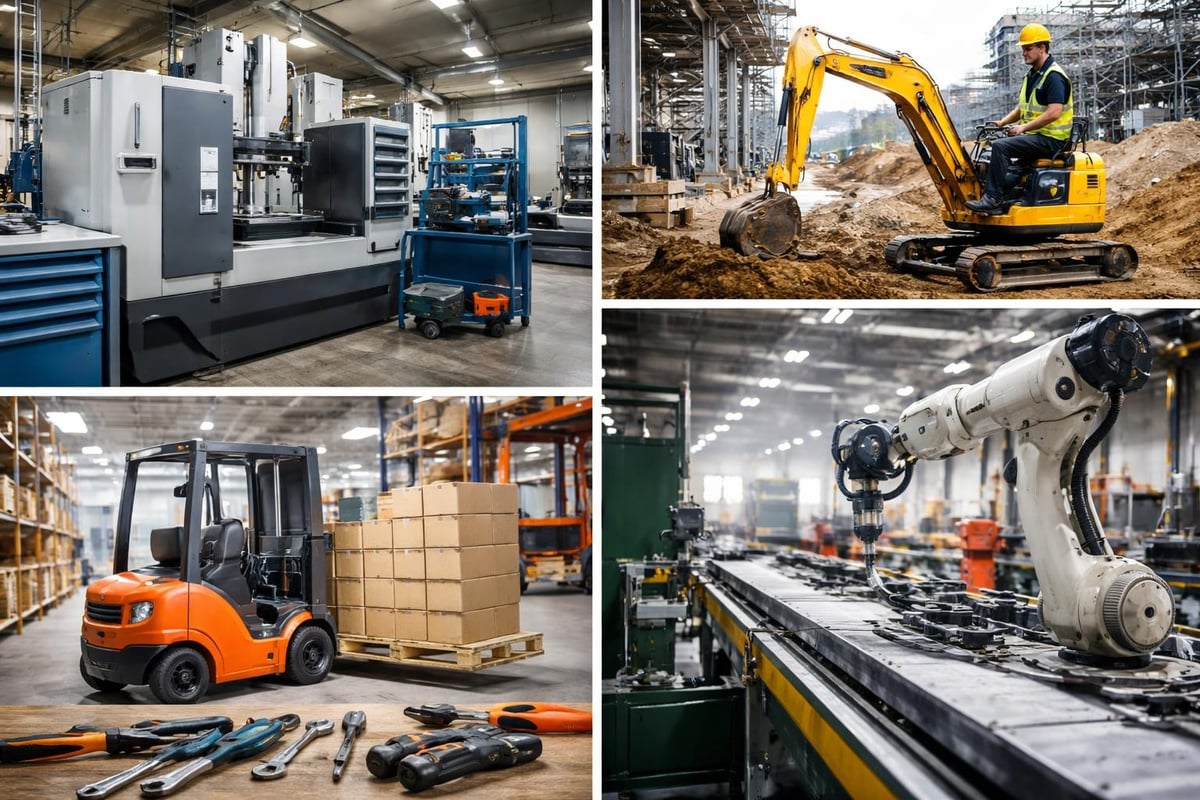
Equipment used by employees, contractors, or visitors all falls within PUWER's scope. Importantly, the regulations apply whether equipment is owned, leased, hired, or borrowed. This creates clear responsibilities for businesses to ensure all puwer equipment meets safety standards regardless of ownership arrangements.
Mobile Work Equipment Considerations
Mobile work equipment requires particular attention under PUWER regulations. This category includes vehicles, powered access platforms, ride-on machinery, and similar equipment designed to move during operation.
Equipment Type | Key PUWER Requirements | Common Risks |
|---|---|---|
Forklift trucks | Operator training, stability systems, maintenance | Overturning, collision, load falling |
Mobile elevated work platforms | Fall protection, stability controls, inspection | Falls from height, entrapment |
Agricultural vehicles | Roll-over protection, emergency stops | Overturning, entanglement |
Site dumpers | Seat belts, visibility aids, braking systems | Collision, rollover, pedestrian contact |
Regulation 25 specifically addresses mobile work equipment, requiring additional safety measures such as protection against rolling over, measures to prevent crushing if equipment overturns, and controls preventing unauthorised starting or use.
Core Legal Requirements for PUWER Equipment
PUWER establishes specific duties that employers must fulfil to ensure work equipment safety. These requirements create a structured approach to equipment management from selection through to disposal.
Suitability and Capability
Regulation 4 requires that puwer equipment must be suitable for the intended use or properly adapted for that purpose. Equipment selection must consider the working conditions, risks present in the workplace, and the specific tasks to be performed.
Suitability assessment involves:
Task analysis to identify equipment specifications needed
Environmental factors including temperature, moisture, and atmospheric conditions
Operator capabilities and any specific needs or limitations
Risk assessment identifying hazards associated with equipment use
Integration with existing systems and processes
Employers cannot simply purchase equipment based on cost or availability. The Health and Safety Executive guidance emphasises that equipment must be genuinely suitable for the specific workplace context and tasks.
Maintenance and Inspection Obligations
Regular maintenance forms a cornerstone of PUWER compliance. Regulation 5 mandates that equipment must be maintained in efficient working order and good repair. This extends beyond reactive repairs to encompass planned preventative maintenance programmes.
Maintenance requirements include:
Establishing maintenance schedules based on manufacturer recommendations and risk assessment
Keeping maintenance logs documenting all work performed
Using competent personnel for maintenance activities
Ensuring maintenance doesn't introduce new hazards
Verifying equipment safety after maintenance work
Regulation 6 requires inspection where equipment safety depends on installation conditions or equipment is exposed to deteriorating conditions. PUWER inspections must be carried out by competent persons at suitable intervals, with results recorded and retained until the next inspection.

Specific Safety Requirements
Regulations 11 through 24 establish detailed safety requirements for puwer equipment addressing hazards commonly encountered across different equipment types.
Protection against specific hazards includes:
Dangerous parts must be guarded or protected (Regulation 11)
Protection against specified hazards including articles or substances falling or being ejected, rupture, fire, explosion, and electrical hazards (Regulation 12)
High or very low temperatures requiring appropriate protection (Regulation 13)
Controls and control systems must be clearly visible, positioned appropriately, and identifiable (Regulations 14-18)
Isolation from energy sources ensuring safe disconnection and lock-off (Regulation 19)
Stability preventing equipment overturning or moving unexpectedly (Regulation 20)
Lighting adequate for safe operation and maintenance (Regulation 21)
Each requirement addresses specific risks that have historically caused workplace accidents. Implementing these measures systematically reduces injury potential whilst ensuring regulatory compliance.
Implementing Effective PUWER Compliance Programmes
Creating a robust compliance framework requires systematic approaches to equipment management, documentation, and continuous improvement. Successful programmes integrate PUWER requirements into everyday operations rather than treating them as isolated compliance activities.
Risk Assessment and Equipment Selection
Every puwer equipment compliance programme begins with thorough risk assessment. This process identifies hazards, evaluates risks, and determines appropriate control measures before equipment enters the workplace.
Assessment Stage | Key Activities | Documentation Required |
|---|---|---|
Hazard identification | Equipment review, task analysis, historical incident data | Hazard register, equipment specifications |
Risk evaluation | Likelihood and severity assessment, existing controls review | Risk matrices, control effectiveness records |
Control selection | Hierarchy of controls application, equipment specification | Control measures documentation, purchase specifications |
Implementation | Installation, commissioning, verification | Installation records, commissioning certificates |
Review | Monitoring, incident investigation, periodic reassessment | Inspection reports, incident logs, review records |
The risk assessment informs equipment specification, purchasing decisions, and operational procedures. Businesses should maintain documented evidence demonstrating that equipment selection considered workplace-specific factors and regulatory requirements.
Training and Competence Development
Regulation 9 requires that persons using puwer equipment receive adequate training. This encompasses not only operational training but also understanding of risks, precautions, and emergency procedures.
Effective training programmes address:
Equipment-specific operation covering controls, adjustment, and normal use
Safety features explaining guards, interlocks, and emergency stops
Hazard awareness identifying risks and protective measures
Maintenance requirements for operator-level checks and reporting defects
Emergency procedures including shutdown and incident response
Training must be refreshed periodically and whenever equipment changes, new hazards emerge, or incidents suggest knowledge gaps. Records should document training content, attendees, dates, and competence assessments.
Inspection and Maintenance Scheduling
Establishing appropriate inspection intervals requires balancing regulatory requirements, manufacturer guidance, risk assessment findings, and operational experience. Inspection frequency varies considerably depending on equipment type, usage intensity, and environmental conditions.
Factors influencing inspection intervals:
Equipment complexity and safety-critical components
Operating environment and exposure to deteriorating conditions
Usage frequency and operational intensity
Historical failure patterns and maintenance records
Manufacturer recommendations and industry standards
Regulatory minimum requirements
Where equipment deteriorates between inspections, more frequent examinations become necessary. Conversely, equipment in controlled environments with low usage may permit longer intervals. Competent persons should determine appropriate frequencies based on evidence rather than arbitrary schedules.
Documentation and Record-Keeping Requirements
PUWER compliance depends heavily on maintaining comprehensive, accessible records demonstrating equipment safety throughout its operational life. Documentation serves multiple purposes including legal compliance, operational management, and incident investigation.
Essential Records and Reports
Regulation 6 specifically requires inspection records, but effective compliance extends beyond this minimum. Comprehensive record systems capture equipment history from acquisition through disposal.
Core documentation includes:
Equipment registers listing all puwer equipment, locations, and key details
Risk assessments for equipment selection, installation, and use
Inspection reports documenting thorough examinations by competent persons
Maintenance logs recording all servicing, repairs, and component replacements
Training records evidencing operator and maintainer competence
Defect notifications tracking identified issues and remedial actions
Incident reports documenting equipment-related accidents or near misses
Records must be retained until the next inspection or for specified periods depending on equipment type. Digital systems increasingly replace paper records, offering improved accessibility, searching, and backup capabilities.
Audit and Review Processes
Regular audits verify that puwer equipment management systems function effectively and comply with legal requirements. Internal audits conducted by competent staff provide ongoing assurance, whilst external audits offer independent verification.

Audit programmes should examine:
Documentation completeness ensuring all required records exist and remain current
Physical equipment condition verifying guards, controls, and safety features function correctly
Procedural compliance confirming safe working practices and control measures operate effectively
Competence verification checking training remains current and adequate
Corrective action effectiveness ensuring identified deficiencies receive appropriate attention
Findings inform continuous improvement initiatives, helping organisations strengthen their workplace health and safety compliance approaches systematically.
Industry-Specific PUWER Applications
Whilst PUWER applies universally, practical implementation varies significantly across different sectors. Understanding industry-specific considerations helps businesses develop targeted, effective compliance programmes.
Manufacturing and Engineering Environments
Manufacturing facilities typically operate extensive ranges of puwer equipment from simple hand tools through complex automated production lines. The HSE's equipment safety guidance addresses sector-specific considerations for different workplace types.
Manufacturing-specific challenges include:
Complex machinery with multiple hazard points requiring comprehensive guarding
Production pressures potentially encouraging shortcuts or guard removal
Equipment modification altering safety characteristics and invalidating certifications
Shift patterns requiring multiple operator training programmes
Confined spaces complicating maintenance access and emergency response
Manufacturing facilities benefit from systematic approaches addressing equipment throughout production processes. Integration with quality management systems creates synergies between safety compliance and production excellence.
Construction and Contracting Operations
Construction sites present unique puwer equipment challenges due to changing work locations, temporary installations, and diverse equipment types operating simultaneously.
Equipment Category | PUWER Considerations | Additional Regulations |
|---|---|---|
Scaffolding | Inspection after installation, modification, or adverse weather | Work at Height Regulations |
Excavators | Stability on varying ground, underground services, visibility | Construction regulations |
Powered tools | Electrical safety, dust control, vibration exposure | COSHH, PPE regulations |
Lifting equipment | Coordination with LOLER requirements | LOLER 1998 |
Contractors must ensure puwer equipment brought to sites meets regulatory standards regardless of ownership. Principal contractors bear responsibilities for coordinating equipment safety across multiple organisations operating simultaneously.
Warehouse and Logistics Operations
Warehouses rely heavily on materials handling equipment subject to PUWER requirements. Forklift trucks, pallet handling equipment, and automated storage systems require particular attention.
High-turnover environments create specific compliance challenges:
Temporary workers requiring rapid yet thorough equipment training
Hire equipment entering sites at short notice
Intensive usage accelerating wear and increasing inspection frequency needs
Mixed operations combining pedestrians with mobile equipment
Seasonal peaks introducing unfamiliar equipment and operators
Effective warehouse compliance programmes emphasise standardisation, clear segregation between pedestrians and vehicles, and robust permit systems for equipment introduction.
Common Compliance Failures and Prevention
Understanding frequent PUWER violations helps organisations avoid similar mistakes and strengthen their compliance approaches. HSE enforcement data reveals recurring themes in non-compliance cases.
Guard Removal and Defeat
Removing or defeating guards represents one of the most common and dangerous PUWER violations. Operators sometimes remove guards to improve access, visibility, or production speed, creating immediate serious risks.
Prevention strategies include:
Designing guards that minimise operational impact whilst maintaining protection
Implementing tool-based guard fastening preventing casual removal
Creating transparent reporting systems for genuine guard access needs
Strengthening supervision and safety culture emphasising guard importance
Regular inspections specifically checking guard presence and effectiveness
Disciplinary procedures addressing deliberate guard interference
Guards must prevent access to dangerous parts whilst allowing necessary operational and maintenance activities. Where guards interfere with legitimate work, engineering solutions should address root causes rather than accepting guard removal.
Inadequate Inspection and Maintenance
Failures to maintain puwer equipment appropriately or conduct required inspections create gradual safety deterioration. Components wear, guards become damaged, and safety features fail without proper attention.
Prevention requires:
Documented maintenance schedules based on risk assessment and manufacturer guidance
Competent inspection personnel with appropriate qualifications and experience
Defect reporting systems enabling immediate notification of safety concerns
Equipment isolation during maintenance preventing inadvertent operation
Post-maintenance verification confirming safety restoration before return to service
Businesses should treat inspection and maintenance as core operational activities rather than administrative burdens. Investment in preventative maintenance typically reduces overall costs whilst improving safety and equipment reliability.
Training Deficiencies
Inadequate operator training contributes to numerous puwer equipment incidents. Training failures include absence of formal instruction, outdated content, language barriers, and insufficient assessment of competence.
Comprehensive training programmes address:
Equipment-specific operational procedures and controls
Hazard recognition and risk awareness
Guard and safety device functions
Prohibited activities and forbidden modifications
Emergency procedures and shutdown processes
Reporting requirements for defects or concerns
Training should be documented, regularly refreshed, and verified through practical competence assessment. New employees, temporary workers, and contractors require particular attention ensuring they possess necessary knowledge before equipment operation.
Managing Equipment Throughout Its Lifecycle
Effective PUWER compliance extends from equipment specification through decommissioning. Lifecycle management ensures safety considerations inform every stage of equipment ownership.
Acquisition and Installation
Equipment safety begins during procurement. Specifications should explicitly require compliance with PUWER and relevant product safety directives. CE marking indicates conformity with European product safety standards, though this doesn't eliminate employer PUWER duties.
Installation requires:
Site preparation ensuring foundations, services, and access meet equipment needs
Commissioning verification confirming correct installation and safety feature operation
Initial inspection by competent persons before operational use begins
Operator familiarisation introducing equipment safely under supervision
Documentation including manuals, certificates, and as-installed drawings
Never assume new equipment automatically complies with PUWER. Verification through independent inspection provides assurance whilst identifying any installation deficiencies requiring correction.
Modification and Adaptation
Equipment modifications present significant compliance challenges. Changes may invalidate CE marking, alter risk profiles, and require updated assessments and training. PUWER requires that adapted equipment remains suitable and safe for its modified purpose.
Before modifying puwer equipment, organisations should:
Conduct risk assessment identifying modification impacts
Consult manufacturers regarding warranty and safety implications
Engage competent engineers for design and implementation
Document modifications comprehensively including drawings and specifications
Commission independent inspection verifying continued safety
Update training, procedures, and risk assessments accordingly
Unauthorised modifications represent serious compliance failures potentially creating criminal liability. Formal change management processes prevent casual alterations whilst enabling legitimate improvements through proper channels.
Decommissioning and Disposal
Equipment reaching end-of-life requires controlled decommissioning preventing continued unsafe use. Disposal processes should address environmental requirements whilst ensuring equipment cannot be reintroduced to workplaces in unsafe conditions.
Decommissioning steps include:
Formal withdrawal from service with equipment register updates
Physical isolation from energy sources
Clear marking indicating non-operational status
Removal from premises or secure storage preventing inadvertent use
Disposal through appropriate channels considering environmental obligations
Record retention documenting equipment history until disposal
Equipment transferred to other organisations remains subject to PUWER. Sellers should ensure purchasers understand equipment condition, any limitations, and maintenance requirements to prevent creating downstream safety problems.
Managing puwer equipment effectively requires systematic approaches addressing selection, operation, maintenance, inspection, and lifecycle management. Businesses must embed PUWER compliance into everyday operations rather than treating it as an isolated regulatory obligation. Workplace Inspection Services Ltd provides expert, independent inspections helping organisations across the UK maintain compliance, manage risk, and create safer working environments through thorough examinations under PUWER and complementary regulations. Their nationwide coverage and specialist expertise support businesses in meeting their statutory obligations whilst protecting employees from equipment-related hazards.