Health and Safety Regulations: A Complete UK Guide
Health and Safety Regulations: A Complete UK Guide

Understanding and implementing health and safety regulations forms the cornerstone of responsible workplace management across the United Kingdom. These regulations exist to protect workers, visitors and the public from harm whilst establishing clear legal obligations for employers and duty holders. For organisations operating with machinery, lifting equipment, pressure systems or hazardous substances, navigating the complex landscape of statutory requirements demands both knowledge and diligence. This comprehensive guide explores the fundamental aspects of workplace safety legislation, helping businesses understand their obligations and implement effective compliance strategies.
The Legislative Framework Underpinning Workplace Safety
The Health and Safety at Work etc. Act 1974 serves as the primary legislation governing workplace safety in the UK. This Act establishes the general duties of employers, employees, contractors and others to ensure health, safety and welfare at work.
Under this framework, employers must protect the health, safety and welfare of their employees and others who might be affected by their work activities. This includes providing safe systems of work, maintaining equipment in safe condition, ensuring safe handling of substances, and providing necessary information, instruction, training and supervision.
Key obligations under the Act include:
Conducting comprehensive risk assessments
Implementing control measures to mitigate identified risks
Providing adequate welfare facilities
Consulting with employees on safety matters
Appointing competent persons to oversee safety compliance
The Act also empowers the Health and Safety Executive (HSE) to enforce regulations, conduct inspections, issue improvement and prohibition notices, and prosecute offenders. Understanding these regulatory frameworks provides essential context for businesses developing their safety management systems.
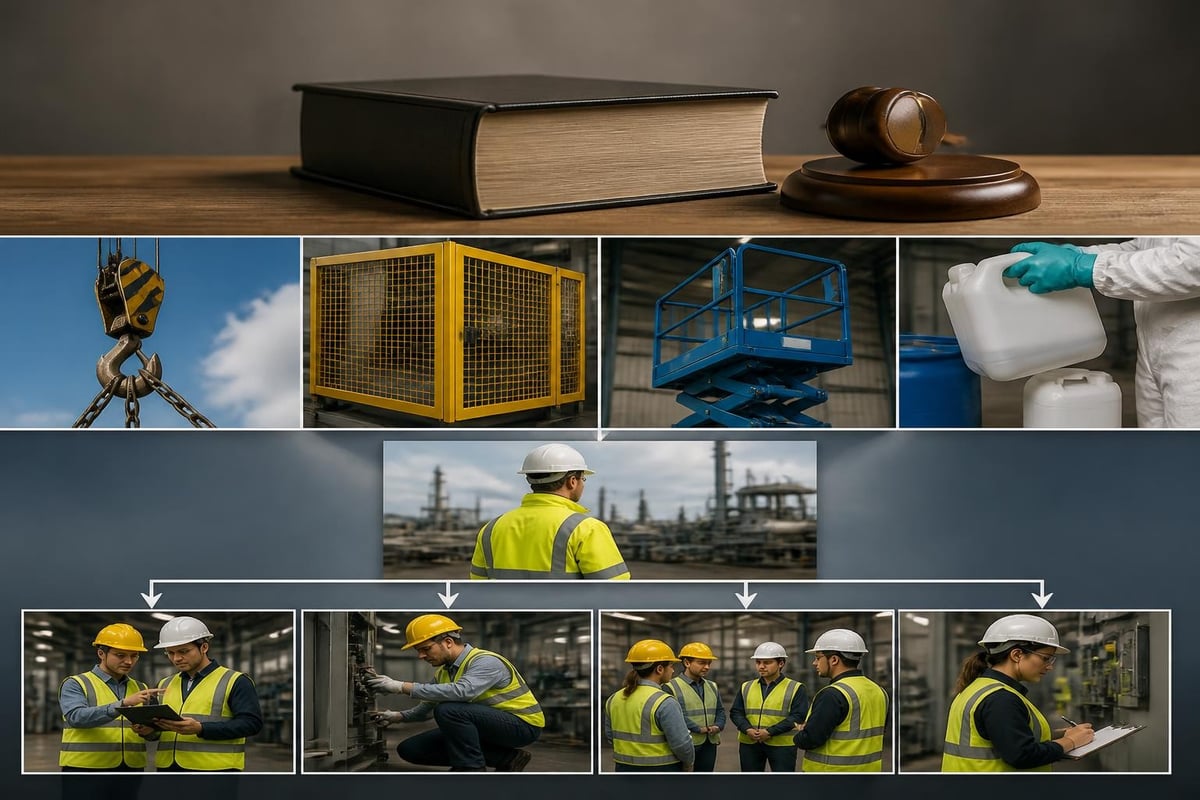
Specific Regulations Governing Equipment and Substances
Beyond the overarching framework, health and safety regulations encompass numerous specific legislative instruments addressing particular workplace hazards and equipment types. These regulations provide detailed requirements tailored to specific risks.
LOLER: Lifting Operations and Lifting Equipment Regulations 1998
The Lifting Operations and Lifting Equipment Regulations 1998 apply to any equipment used for lifting or lowering loads, including people. This encompasses cranes, hoists, lift trucks, mobile elevating work platforms, and lifting accessories such as chains, slings and shackles.
LOLER Inspections require that all lifting equipment undergoes thorough examination by a competent person at specified intervals, typically every six or twelve months depending on the equipment type and usage. These examinations verify that equipment remains safe for continued use and identify any defects requiring attention.
LOLER Requirement | Description | Frequency |
|---|---|---|
Thorough examination (new/installed) | Before first use or after installation | One-time |
Thorough examination (ongoing) | Regular statutory inspection | 6-12 months |
Inspection after exceptional circumstances | Following damage, modification or significant repair | As required |
Record keeping | Documentation of all examinations | Duration of use + 2 years |
PUWER: Provision and Use of Work Equipment Regulations 1998
PUWER applies broadly to work equipment across all sectors, from hand tools to complex machinery. The regulations require equipment to be suitable for its intended purpose, maintained in efficient working order, and used only by trained personnel.
Regular inspections under PUWER ensure machinery guards function correctly, emergency stops operate effectively, and equipment remains fit for purpose. The regulation scope extends to manufacturing equipment, workshop machinery, power presses and processing systems.
PSSR: Pressure Systems Safety Regulations 2000
Pressure systems including air receivers, steam boilers, autoclaves and associated pipework fall under PSSR requirements. These regulations mandate written schemes of examination, regular inspections by competent persons, and careful management of pressure system modifications.
The regulations address the significant risks associated with stored energy in pressurised systems, requiring robust examination protocols to prevent catastrophic failures. More information about statutory inspection requirements can help businesses understand their specific obligations.
COSHH: Control of Substances Hazardous to Health Regulations 2002
COSHH regulations protect workers from health risks associated with hazardous substances including chemicals, fumes, dusts, vapours, mists and biological agents. Employers must assess risks, implement control measures, and maintain effective local exhaust ventilation (LEV) systems where required.
LEV systems require thorough examination and testing at least every 14 months to ensure they effectively remove or reduce exposure to harmful substances. These examinations verify airflow rates, capture efficiency and overall system performance.
Risk Assessment: The Foundation of Compliance
Effective health and safety regulations compliance begins with comprehensive risk assessment. This systematic process identifies workplace hazards, evaluates associated risks, and determines appropriate control measures.
The five-step approach to risk assessment provides a structured methodology:
Identify hazards - Recognise anything that could cause harm
Determine who might be harmed - Consider employees, contractors, visitors and the public
Evaluate risks and implement controls - Assess likelihood and severity, then apply the hierarchy of controls
Record findings - Document significant findings and implementation plans
Review and update - Regularly revisit assessments, especially after incidents or changes

The Hierarchy of Controls
When implementing control measures, health and safety regulations encourage following the hierarchy of controls, prioritising measures by effectiveness:
Most Effective:
Elimination - Remove the hazard entirely
Substitution - Replace with less hazardous alternatives
Engineering controls - Isolate people from hazards through physical means
Moderately Effective:
Administrative controls - Change work procedures and policies
Personal protective equipment - Provide barriers between workers and hazards
This approach ensures organisations implement the most effective solutions rather than relying solely on PPE or procedural controls. The NIOSH authoritative recommendations provide evidence-based guidance on implementing effective control strategies.
Competent Persons and Statutory Inspections
Health and safety regulations frequently reference the requirement for "competent persons" to conduct examinations, assessments and inspections. Competence encompasses both adequate training and sufficient knowledge, experience and other qualities.
For statutory inspections under LOLER, PUWER, PSSR and COSHH/LEV, organisations must engage competent persons with appropriate qualifications and experience. This typically involves independent engineering inspection companies specialising in these regulatory areas.
Inspection Frequencies and Requirements
Different regulations specify varying inspection frequencies based on equipment type, usage intensity and risk level:
Regulation | Equipment Type | Typical Frequency |
|---|---|---|
LOLER | Lifting equipment (general) | 12 months |
LOLER | Lifting equipment (people) | 6 months |
PUWER | Power presses (HSG236) | 12 months |
PSSR | Pressure systems | Per written scheme |
COSHH/LEV | Ventilation systems | 14 months |
Understanding inspection frequency requirements helps businesses plan maintenance schedules and budget appropriately for compliance activities.
Thorough examinations must be documented, with reports identifying defects, specifying remedial timeframes, and confirming whether equipment remains safe for continued use. These records form crucial evidence of regulatory compliance and due diligence.
Training, Information and Supervision Requirements
Compliance with health and safety regulations extends beyond physical equipment to encompass human factors. Employers must ensure all personnel receive adequate training, information and supervision appropriate to their roles and responsibilities.
Training requirements vary according to specific tasks and equipment but generally include:
Induction training - General workplace safety awareness for new employees
Equipment-specific training - Instruction on safe operation of machinery and equipment
Refresher training - Periodic updates to maintain competence
Emergency procedures - Response protocols for incidents and equipment failures
Supervisory training - Additional competencies for those overseeing others
Effective training programmes combine theoretical knowledge with practical demonstration, assessment of understanding, and documented records. The regulatory landscape continues evolving, making ongoing training essential for maintaining current knowledge.
Documentation and Record Keeping Obligations
Comprehensive documentation forms an integral component of health and safety regulations compliance. Records serve multiple purposes: demonstrating regulatory compliance, supporting continuous improvement, providing evidence of due diligence, and informing future risk assessments.
Essential documentation includes:
Risk assessments and method statements
Inspection and examination reports
Maintenance records and repair logs
Training records and competency certificates
Incident reports and investigation findings
Written schemes of examination (for pressure systems)
Safety policies and procedures
Record retention periods vary by regulation, but organisations should generally maintain examination reports for the equipment's operational life plus at least two years. The compliance hub provides resources for understanding documentation requirements across different regulatory frameworks.
Enforcement, Penalties and Consequences of Non-Compliance
The Health and Safety Executive enforces health and safety regulations through workplace inspections, investigations following incidents, and responses to complaints. HSE inspectors possess significant powers including the right to enter premises, examine equipment, take samples, and interview personnel.
Enforcement Actions
When inspectors identify non-compliance, they may take several actions depending on severity:
Verbal advice - Informal guidance for minor issues
Improvement notices - Legal requirement to address specified problems within a defined timeframe
Prohibition notices - Immediate cessation of dangerous activities until risks are controlled
Prosecution - Criminal proceedings for serious breaches
Recent years have seen substantial increases in penalties for health and safety offences. Following the introduction of sentencing guidelines in 2016, fines for serious breaches regularly reach hundreds of thousands of pounds, with the largest penalties exceeding several million pounds.
Beyond financial penalties, directors and senior managers can face personal liability, disqualification from holding company positions, and imprisonment for serious breaches. Understanding workplace health and safety compliance helps organisations avoid these severe consequences.

Industry-Specific Applications and Considerations
Whilst core health and safety regulations apply across sectors, certain industries face unique challenges and additional regulatory requirements. Manufacturing, construction, energy, mining and chemical processing each encounter specific hazards demanding tailored approaches.
Manufacturing environments typically involve numerous regulations simultaneously. A single facility might operate lifting equipment under LOLER, machinery under PUWER, compressed air systems under PSSR, and welding fume extraction under COSHH. This complexity requires coordinated compliance strategies addressing multiple regulatory frameworks.
Construction sites face dynamic risk environments with changing hazards, multiple contractors, and temporary structures. The Construction (Design and Management) Regulations 2015 impose additional duties on clients, designers, principal designers and principal contractors beyond standard health and safety regulations.
Energy sector operations encounter Department of Energy regulations alongside UK-specific requirements, particularly for nuclear facilities and major hazard installations. These environments demand heightened safety protocols and additional regulatory oversight.
Mining operations fall under both general health and safety regulations and specific mining regulations addressing underground working, ventilation, explosive atmospheres and ground stability. The Mine Safety and Health Administration standards provide comparative international perspectives on mining safety requirements.
Developing Effective Safety Management Systems
Compliance with health and safety regulations requires systematic approaches rather than ad-hoc responses to individual requirements. Effective safety management systems integrate regulatory obligations into everyday business operations.
Key components of robust safety management include:
Leadership commitment - Visible senior management support for safety priorities
Clear organisational structure - Defined safety roles and responsibilities
Planning and implementation - Structured approaches to identifying and controlling risks
Measurement and review - Regular monitoring of safety performance
Continuous improvement - Learning from incidents and near misses
Many organisations adopt formal frameworks such as ISO 45001 (Occupational Health and Safety Management Systems) to structure their approach. These systems provide internationally recognised standards for managing workplace safety systematically.
Effective implementation requires embedding safety into procurement processes, design decisions, operational procedures and performance management. Regular audits, both internal and external, verify compliance and identify improvement opportunities.
The Role of Technology in Compliance Management
Modern technology offers powerful tools for managing health and safety regulations compliance more efficiently. Digital solutions streamline documentation, automate reminder systems, and provide real-time visibility of compliance status.
Inspection management software enables organisations to schedule examinations, track due dates, manage findings, and maintain comprehensive digital records. These systems reduce administrative burden whilst improving accuracy and accessibility of compliance data.
Mobile applications allow inspectors to complete examinations on-site using tablets or smartphones, capturing photographs, recording measurements, and generating reports immediately. This technology eliminates transcription errors and accelerates report delivery.
Asset management platforms integrate safety compliance with broader maintenance management, linking statutory inspections to planned maintenance activities. This integration ensures regulatory requirements align with operational maintenance strategies.
Data analytics capabilities enable organisations to identify trends, predict equipment failures, and optimise inspection schedules based on actual performance rather than fixed intervals. These insights support proactive rather than reactive safety management.
Brexit Implications and Regulatory Divergence
Following the UK's departure from the European Union, health and safety regulations previously derived from EU directives have been retained in UK law. However, potential for regulatory divergence exists as the UK government considers future modifications.
Currently, core regulations including LOLER, PUWER, PSSR and COSHH remain substantially unchanged. The Health and Safety Executive continues enforcing these requirements, and businesses maintain existing compliance obligations.
Organisations operating across multiple jurisdictions must monitor potential differences emerging between UK and EU requirements. Companies with operations in Northern Ireland face particular complexity due to the Northern Ireland Protocol's continued alignment with certain EU standards.
State-specific variations exist in other jurisdictions, with state safety and health standards demonstrating how regional differences can affect compliance requirements. UK businesses should remain alert to potential future divergence requiring adapted compliance strategies.
Future Trends and Emerging Challenges
The landscape of health and safety regulations continues evolving in response to technological advancement, emerging risks, and changing work patterns. Several trends shape the future regulatory environment.
Automation and robotics introduce new hazards whilst potentially eliminating others. Regulations must adapt to collaborative robots working alongside humans, autonomous vehicles in warehouses, and AI-driven systems making safety-critical decisions.
Remote and hybrid working challenges traditional workplace safety models. Employers retain duty of care for home workers, requiring risk assessments of home workspaces and provision of appropriate equipment.
Mental health and psychosocial risks receive increasing regulatory attention. Whilst current health and safety regulations encompass mental health, expect more specific guidance and potentially new requirements addressing workplace stress, bullying and psychological wellbeing.
Climate change adaptation will likely influence future regulations as extreme weather events, higher temperatures and changing environmental conditions create new workplace hazards requiring regulatory responses.
Global supply chain complexity demands enhanced due diligence to ensure suppliers and contractors maintain appropriate safety standards. Regulatory frameworks may expand to address modern slavery, supply chain transparency and international safety standards.
Staying informed about regulatory developments through resources such as the CDC regulations portal helps organisations anticipate changes and adapt proactively.
Integrating Safety Culture with Regulatory Compliance
Whilst health and safety regulations establish minimum legal requirements, leading organisations recognise that genuine safety excellence requires cultural transformation beyond mere compliance. Regulations provide the floor, not the ceiling, for safety performance.
Effective safety culture combines regulatory compliance with intrinsic commitment to protecting people. This involves moving from "we comply because we must" to "we protect people because it's right." Leadership behaviour, workforce engagement, and organisational values all contribute to this cultural foundation.
Consultation with employees generates practical insights into workplace hazards and effective control measures. Workers performing tasks daily often identify risks and solutions that remote assessments might miss. Health and safety regulations mandate this consultation, but effective organisations embrace it as a source of continuous improvement.
Incident reporting and investigation systems should encourage reporting of near misses and unsafe conditions, not just actual injuries. Learning from events that could have caused harm prevents future incidents. A blame-free reporting culture, supported by robust investigation processes, enables organisations to identify systemic issues requiring attention.
Recognition and reward systems can reinforce desired safety behaviours, celebrating proactive hazard identification, intervention to prevent unsafe acts, and contributions to safety improvement. Aligning performance management with safety objectives ensures all personnel understand their safety responsibilities.
Navigating the complex landscape of health and safety regulations requires expert knowledge, systematic processes and ongoing commitment to compliance. By understanding regulatory frameworks, implementing robust safety management systems, and fostering a culture of continuous improvement, organisations protect their workforce whilst fulfilling legal obligations. Workplace Inspection Services Ltd supports businesses nationwide with independent engineering inspections under LOLER, PUWER, PSSR and COSHH/LEV regulations, helping organisations maintain compliance, reduce risk and create safer working environments across the UK.